
Year: 2022
Collections: Policy Briefs
Topics: Sustainable Development
Authors: Samekina S., Issayeva G.
Countries: Kazakhstan
Source:
An individual monotown is a unique combination of available resources, trends and potential. Earlier management decisions, due to their uniformity, did not take such specifics into account. As a result, state support measures have not had the expected effect. The introduction of a differentiated approach to regional policy transformation can therefore be a trigger for positive change.
Year: 2021
Collections: Scientific Publications
Topics: Agriculture
Authors: Salmukhanbetova Zh.K., Imanalinova A. A., Dimeyeva L. A., Zverev N.E.
Countries: Kazakhstan

Year: 2021
Collections: Research Paper
Topics: Agriculture
Authors: Beishenaly Nazik, Dufays Frédéric
Countries: Kazakhstan
Source:
Year: 2021
Collections: Scientific Publications, Review article
Topics: Water, Water diplomacy
Authors: Juho Haapala, Marko Keskinen, Erik Salminen
Countries:
Source: Journal of Hydrology
In this article, we seek to contribute to the practice of water diplomacy by introducing a step-wise Water Diplomacy Paths approach for analysing different water diplomacy contexts and related water diplomacy actions. To facilitate this, we recognise five key aspects for water diplomacy (Political; Preventive; Integrative; Cooperative; Technical) and propose a general definition for water diplomacy. We also discuss the possible distinctions between the related concepts of water diplomacy and transboundary water cooperation. The use of the Water Diplomacy Paths approach is demonstrated with brief case studies focusing on Central Asia, the Mekong Region, and the Finnish-Russian water cooperation. The work builds on an extensive literature review and comparative analysis of water diplomacy approaches as well as on a series of workshops and interviews among selected water diplomacy actors, including career diplomats.

Year: 2021
Collections: Research Paper
Topics: Water
Authors: Sharakhmetov S.E., Barakbayev T.R., Adayev T.O.
Countries: Kazakhstan
Year: 2021
Collections: Research Paper
Topics: Water, Water law, Water Security, Transboundary cooperation, Hydropolitics
Authors: Abdulsalam Amini, Hamidreza Jafari, Bahram Malekmohammadi, Touraj Nasrabadi
Countries: Iran Turkmenistan, Afghanistan,
Source: Discrete Dynamics in Nature and Society
The present paper aims to analyze, using the Graph Model for Conflict Resolution (GMCR), a game theory model, the conflict between the three countries regarding the utilization of the water resources of the border river, Harirud. To this purpose, first, the current state of the conflict was investigated.
Year: 2021
Collections: Research Paper
Topics: Irrigation
Authors: Asfaw Etenesh B.
Countries: Uzbekistan
Source:

Year: 2021
Collections: Scientific Publications, Review article
Topics: Water, Water law, Water diplomacy
Authors: Susanne Schmeier
Countries:
Source: American Journal of International Law, 115, 173-177
International water law (IWL) principles are often called upon to address disagreements and conflict between riparian states to a shared watercourse, with various parties invoking them to guide states’ behavior towards cooperative solutions that benefit the water resources as well as broader regional cooperation and peace. This essay argues that it is particularly important to acknowledge the role IWL principles play in negotiation processes, that is, in an ex ante and non-judicial function, providing a framework for cooperation and contributing to lawmaking, which makes them important tools of international relations and water diplomacy.
Year: 2021
Collections: Scientific Publications
Topics: Agriculture
Authors: Asfaw Etenesh B.
Countries: Uzbekistan
Source: Central Asian Journal of Water Research
https://water-ca.org/article/state-led-cotton-deregulation-in-uzbekistan-reforms-and-effects
Uzbekistan’s cotton supply chain experienced a wave of deregulation reforms in the last five years. This paper attempts to assess the process and results of the State-driven transition from the centrally planned cotton sector to private cotton-textile clusters. The article employs secondary data sources to analyse the effects of the deregulation policies descriptively. The study reveals that the deregulation reforms increased productivity in the sector. The reform initiatives also vertically integrated the cotton supply chain from production to marketing. However, the reforms failed to transparently incorporate and harmonise the needs of cotton farmers that grow and sell raw cotton. Consequently, the promises of the State-led deregulation reforms and initiatives are eroded. The article highlights the emerging risks and tensions in the current cotton liberalisation and privatisation reforms in Uzbekistan.
Year: 2021
Collections: Research Paper
Topics: IWRM
Authors: Alamanos A., Zeng Q.
Countries: N/A
Year: 2021
Collections: Scientific Publications, Research Paper
Topics: Water
Authors: Адаев Т., Баракбаев Т., Шарахметов С.
Countries: Kazakhstan

Year: 2021
Collections: Research Paper
Topics: IWRM
Authors: Alamanos A.
Countries: N/A
Year: 2021
Collections: Scientific Publications
Topics: Agriculture
Authors: Beishenaly Nazik, Dufays Frédéric
Countries: Kyrgyzstan
Year: 2021
Collections: Scientific Publications
Topics: Water
Authors: Assubayeva A.
Countries: Kazakhstan, Kyrgyzstan, Uzbekistan, Tajikistan, Turkmenistan
Year: 2021
Collections:
Topics: Climate, Sustainable Development, IWRM, Water diplomacy, Transboundary Water Resources, Water Security
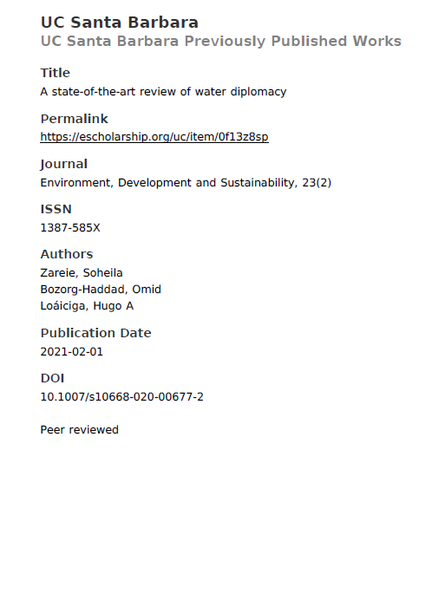
Authors: Soheila Zareie, Omid Bozorg‑Haddad, Hugo A. Loáiciga
Countries:
Source: Environment, Development and Sustainability
Diplomacy is the art and skill of managing international relations through negotiations between representatives of states or agencies. Water diplomacy is an innovative approach and strategic tool to resolve water issues at local and trans-boundary scales when water conflicts rise in sharing water resources. Complex water supply and sharing issues arise from the existence of multiple stakeholders such as agriculture, industry, urban and domestic users, environmental use, and others competing for scarce water. Water diplomacy may contribute to solving a variety of water conflicts and in this sense is a tool for sustainable water resources management.
For questions about cooperation, please contact us at: