
Year: 2024
Collections: Scientific Publications
Topics: Water
Authors: Шарахметов С., Бараков Р.Т., Исбеков К.Б., Нуртазин С.Т.
Countries: Kazakhstan
Source: https://water-ca.org
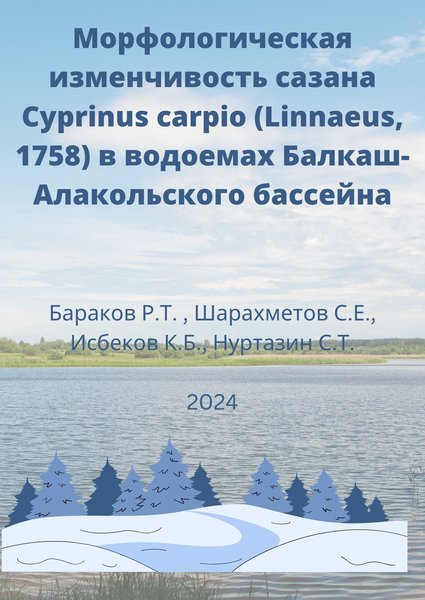
В статье приведены результаты изучения морфологической изменчивости сазана (Cyprinus carpio Linnaeus, 1758) в пределах трех крупных водоемов Балкаш-Алакольского бассейна – оз. Балкаш, оз. Алаколь и Капшагайского водохранилища. По трем выборкам сазана обнаружены морфологические различия по ряду признаков (счетные и пластические). При анализе внешних признаков были изучены 24 пластических и 14 счетных признаков. С применением метода обработки цифровых изображений (MorphoJ) проанализированы различия сазана по форме тела. Применение метода главных компонент (PCA) позволило определить основные нагрузки на изученные морфологические признаки сазана. Выявленные статистически достоверные различия позволяют говорить о том, что формирование морфологических изменений сазана было вызвано длительностью адаптивной радиации, средовыми факторами водоемов и ежегодным искусственным зарыблением молодью.
Year: 2024
Collections: Scientific Publications
Topics: Water
Authors:
Countries: Kazakhstan
Source: https://water-ca.org/
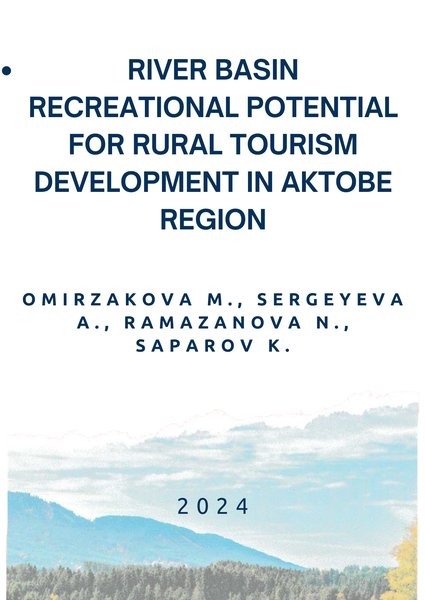
The aim of the research was to analyze the climate comfort and assess the recreational potential of river basins for the development of rural tourism in Aktobe Region, Kazakhstan.
Year: 2024
Collections: Scientific Publications
Topics: Energy
Authors: Hans Holzhacker, Botagoz Rakisheva
Countries: Kyrgyzstan, Uzbekistan, Tajikistan
Source: Central Asian Journal of Sustainability and Climate Research
In July-August, 2023, CAREC Institute, Public Opinion Research Institute, and Asian Development Bank Institute conducted a sociological survey on household energy use in the Fergana Valley spanning over the Kyrgyz Republic, Tajikistan, and Uzbekistan. The following article uses the data from that survey for investigating what determines the choice of different energy types for heating. The article concludes that high household expenditures for coal and high awareness of the harm fossil fuels can inflict on the environment and family health are insufficient to trigger a large-scale shift towards cleaner energy. To motivate households for such a shift a substantial increase in fossil fuel prices compared to electricity and other clean energy is required. This might call for a sales tax on coal. However, energy expenditure already accounts for up to one-third of household income. Low- and middle-income households would need to be compensated for increased energy spending to avoid social hardship and a backlash against such a tax.
Year: 2023
Collections: Scientific Publications
Topics: Climate
Authors: Борисова Ю.С.
Countries: Kazakhstan
Source: Цетральноазиатский журнал исследования климата и устойчивого развития
Процессы изменения климата происходят в глобальном масштабе и сопровождаются выбросами в атмосферу значительных количеств парниковых газов, преобладающими из которых являются оксид углерода и диоксид углерода. В аналитическом обзоре представлены результаты состояния изученности и оценки существующих исследований по секвестированию углерода лесными насаждениями. Леса играют ключевую роль в изменении климата, поглощая большое количество углекислого газа из атмо-сферы. Они являются наиболее важным наземным поглотителем углерода. Два ключевых показателя: биомасса и продуктивность лесов определяют уровень накопления углерода в экосистеме. Методы оценки секвестирования углерода лесными насаждениями включают использование различных моделей, таких как InVEST, CO2FIX, CBM-CFS3 и других.
Year: 2023
Collections: Research Paper
Topics: Climate
Authors: Кусаинова Майра, Тойшиманов М.Р., Таменов Т.Б., Сыздык А.Б., Джикуан Ч.
Countries: Kazakhstan
Source: Central Asian Journal of Water Research
Актуальность исследований состоит в использовании автоматизированной системы непрерывного измерения выбросов CO2 из почвы – Li-8100 (Campbell Scientific) – при применении различных методов обработки почвы (без обработки, навоз и минеральные удобрения) под основные культуры (кукурузу, пшеницу, ячмень) на примере Алматинской области. В статье представлены данные, полученные учеными при проведении полевых исследований в условиях предгорной зоны.
Year: 2023
Collections: Conferences, Video
Topics: Climate
Authors:
Countries: N/A
Source: carececo
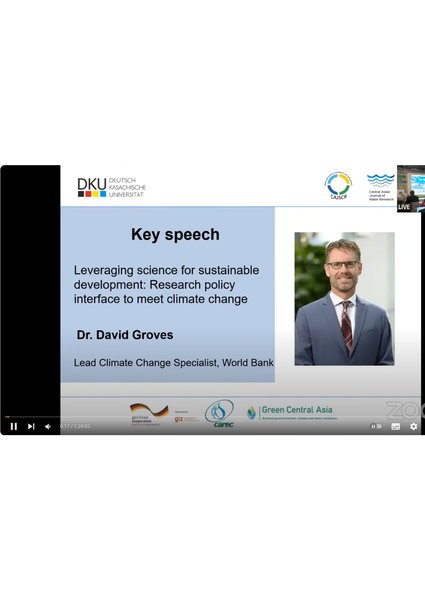
Scientific journal “Central Asian Journal of Sustainability and Climate Research”
December 8th, 2023, 9.30-11.00
Place: Central Asia Pavilion (Zone B2, Building 15), Blue Zone COP28, Expo City Dubai, UAE
Year: 2023
Collections: Research Paper
Topics: Water
Authors: Мухтарова А.
Countries: Kazakhstan, Kyrgyzstan, Uzbekistan, Tajikistan, Turkmenistan
Source: Central Asian Journal of Water Research
Академическая наука определяет отраслевую коррупцию, а именно коррупцию в секторе водного хозяйства, как одну из главных угроз развитию Центральной Азии. Целью данной статьи является анализ академических исследований затрагивающих тему водной коррупции, ее форм и типологий в различных секторах водного хозяйства (таких как водоснабжение и санитария, ирригация, гидроэнергетика и управление водными ресурсами). В частности, исследование направлено на изучение вопроса как коррупция в водном секторе определяется и анализируется в академических источниках в Центральной Азии.
Year: 2023
Collections: Scientific Publications, Review article
Topics: Water, Water governance Water diplomacy,
Authors: Rozemarijn ter Horst, Jenniver Sehring, Alexandra Said
Countries:
Source: Journal of Hydrology X
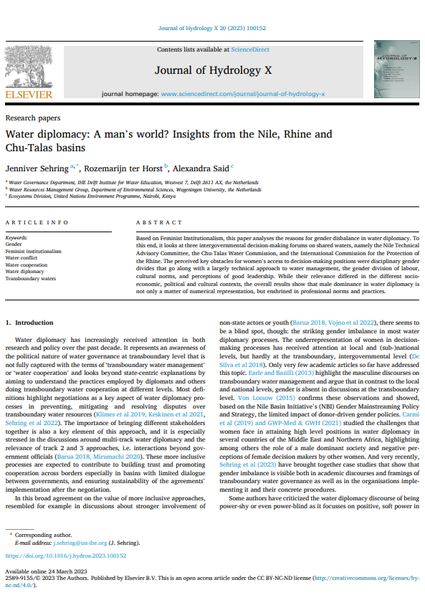
Based on Feminist Institutionalism, this paper analyses the reasons for gender disbalance in water diplomacy. To this end, it looks at three intergovernmental decision-making forums on shared waters, namely the Nile Technical Advisory Committee, the Chu-Talas Water Commission, and the International Commission for the Protection of the Rhine. The perceived key obstacles for women’s access to decision-making positions were disciplinary gender divides that go along with a largely technical approach to water management, the gender division of labour, cultural norms, and perceptions of good leadership. While their relevance differed in the different socioeconomic, political and cultural contexts, the overall results show that male dominance in water diplomacy is not only a matter of numerical representation, but enshrined in professional norms and practices.
Year: 2023
Collections: Research Paper
Topics: Water, Green business
Authors: Hutson N., Taganova J.
Countries: Kazakhstan
Source: Central Asian Journal of Water Research
Recent geopolitical events have thrust the Caspian region into a time of unparalleled opportunity. Specifically, the Middle Corridor (“MC”) has been presented as a potential savior for trans-Eurasian commerce. At the same time, its success relies on a sea that is in an ecologically precarious state.
Year: 2023
Collections: Scientific Publications, Books
Topics: Water diplomacy, Water, Gender, Water governance
Authors: Rozemarijn ter Horst, Jenniver Sehring, Margreet Zwarteveen
Countries:
Source: Routledge. Taylor & Francis
This volume assesses the nexus of gender and transboundary water governance, containing empirical case studies, discourse analyses, practitioners’ accounts, and theoretical refections.
Year: 2023
Collections: Scientific Publications, Review article
Topics: Water, Water diplomacy
Authors: Juho Haapala, Marko Keskinen, Elina Häkkinen, Bota Sharipova
Countries:
Source: Water Alternatives 16(3): 949-977
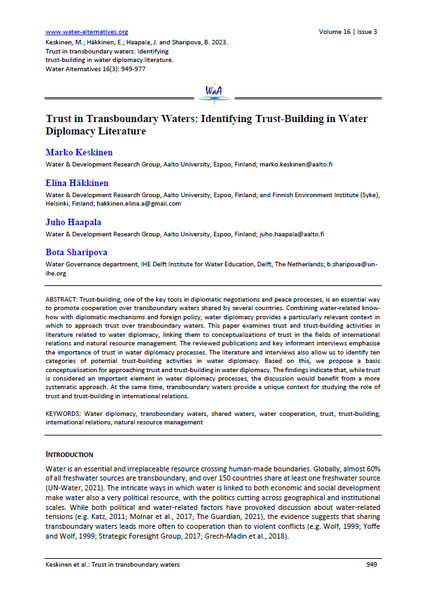
This paper examines trust and trust-building activities in literature related to water diplomacy, linking them to conceptualisations of trust in the fields of international relations and natural resource management. The reviewed publications and key informant interviews emphasise the importance of trust in water diplomacy processes. The literature and interviews also allow us to identify ten categories of potential trust-building activities in water diplomacy.
Year: 2023
Collections: Scientific Publications
Topics: Water
Authors: Кабутов Х.К Каюмов А., Сакс Т., Наврузшоев Х.Д., Восидов Ф.К., Неккадамова Н.М., Халимов А.М.,
Countries: Tajikistan
Source:
Целью данной статьи является расчёт поверхностного баланса массы (SMB) ледника № 139 в бассейне оз. Каракуль, позволяющий на основе полученных результатов оценить степень влияния изменения климата на оледенение данной территории, а также перспективу изменения состояния ледников в будущем.
Year: 2023
Collections: Scientific Publications
Topics: Water
Authors: Оканов К., Калачев А., Роговский С.
Countries: Kazakhstan
Source:
В статье представлены результаты изучения формирования и особенностей снежного покрова в пихтовых насаждениях в сравнении с открытым закустаренным участком в условиях Юго-Западного Алтая, полученные за снежный период 2020–2021 гг.
Year: 2023
Collections: Research Paper
Topics: Water
Authors: Makhmudova L., Mussina A., Ospanova M., Zharylkassyn A., Kanatuly A.
Countries: Kazakhstan
Source: Central Asian Journal of Water Research
The research aimed to assess the impact of human economic activities on the Yesil River Basin based on the observational data contained in Kazhydromet’s (Republic State Enterprise, RSE) hydrometeorological periodicals of 1933-2019. The additional analysis of numerous sources – statistics digests, online data of the Bureau of National Statistics under the Agency for Strategic Planning and Reforms of the Republic of Kazakhstan (RK), monographs and scientific papers also allowed to reliably evaluate the overall water consumption in the country.
Year: 2023
Collections: Scientific Publications
Topics: Energy
Authors: Трофимов Г., Насиров Т.Х., Хамидов Ш.В.
Countries: Kazakhstan, Kyrgyzstan, Uzbekistan, Tajikistan, Turkmenistan
Source: Цетральноазиатский журнал исследования климата и устойчивого развития
В статье рассматриваются экологические проблемы дальнейшего развития энергосистем Центральной Азии (ЦА) на базе традиционных и возобновляемых источников энергии (ВИЭ). Для понимания существующей ситуации с энергетикой и экологией в странах ЦА описан их энергетический профиль и состояние энергетического сектора, используемое топливо, уровень энергоэффективности и износа энергооборудования, уровень потребляемой ими первичной энергии и показана картина распределения выбросов CO2 в этих странах. Однако, учитывая, что в регионе ЦА Казахстан и Узбекистан лидируют и по потребляемой энергии, и по величине выбросов парниковых газов, в статье в большей степени рассматриваются существующие проблемы именно в этих странах.
For questions about cooperation, please contact us at: