
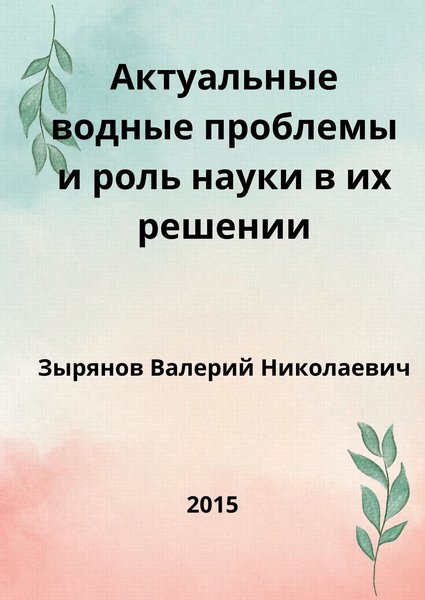
Year: 2015
Collections: Short Communications
Topics: Water, Climate, Energy
Authors: Зырянов Валерий Николаевич
Countries: Kazakhstan, Kyrgyzstan, Uzbekistan, Tajikistan, Turkmenistan
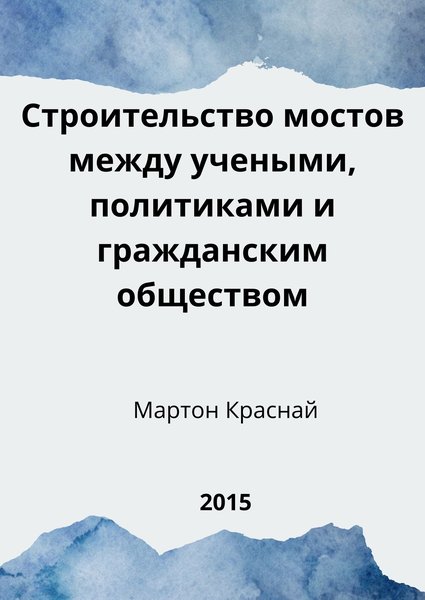
Year: 2015
Collections: Short Communications
Topics: Water, Climate
Authors: Краснай Мартон
Countries: Kazakhstan, Kyrgyzstan, Uzbekistan, Tajikistan, Turkmenistan

Year: 2015
Collections: Short Communications
Topics: Water
Authors: Леонова Татьяна
Countries: Kazakhstan, Kyrgyzstan, Uzbekistan, Tajikistan, Turkmenistan
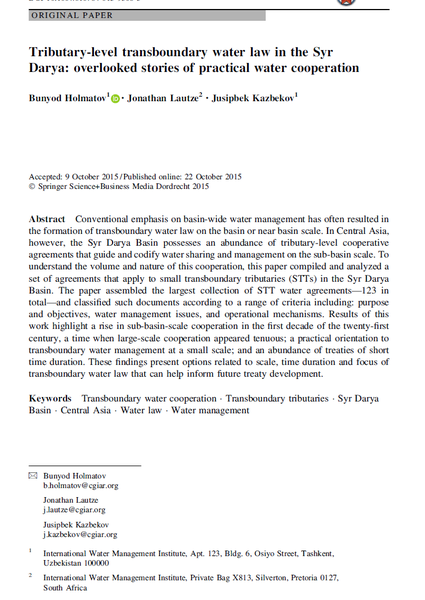
Year: 2015
Collections: Research Paper
Topics: Water, IWRM, Water law, Water governance, Transboundary Water Resources, Transboundary cooperation
Authors: Bunyod Holmatov, Jonathan Lautze, Jusipbek Kazbekov
Countries:
Source: International Environmental Agreements: Politics, Law and Economics
This research presents a systematic analysis of 123 agreements concerning small transboundary tributaries within the Syr Darya River Basin, highlighting the importance of sub-basin cooperation in Central Asia. The study identifies a significant increase in treaty-making activity during the first decade of the 21st century, demonstrating that local-level cooperation can remain effective even when basin-wide cooperation faces challenges. Most of the analyzed agreements are regulatory in nature and focus on technical issues, including water allocation, operation and maintenance of hydraulic infrastructure, and the management of shared water resources.
Year: 2015
Collections: Short Communications
Topics: Sustainable Development
Authors: Зеринг Дженнифер
Countries: Kazakhstan, Kyrgyzstan, Uzbekistan, Tajikistan, Turkmenistan
Year: 2015
Collections: Short Communications
Topics: Water, Climate, Energy
Authors: Остонакулов Тоштемир Эшанович
Countries: Kazakhstan, Kyrgyzstan, Uzbekistan, Tajikistan, Turkmenistan
Year: 2015
Collections: Short Communications
Topics: IWRM
Authors: Кассара Манон
Countries: Kazakhstan, Kyrgyzstan, Uzbekistan, Tajikistan, Turkmenistan
Year: 2015
Collections: Short Communications
Topics: Sustainable Development
Authors: Абдуллаев Искандар Хикматович
Countries: Kazakhstan, Kyrgyzstan, Uzbekistan, Tajikistan, Turkmenistan
Year: 2015
Collections: Short Communications
Topics: IWRM
Authors: Махмадалиев Бегмурод Убайдович
Countries: Kazakhstan, Kyrgyzstan, Uzbekistan, Tajikistan, Turkmenistan
Year: 2015
Collections: Short Communications
Topics: Sustainable Development
Authors: Одинаев Хайдар Одинаевич
Countries: Kazakhstan, Kyrgyzstan, Uzbekistan, Tajikistan, Turkmenistan
Year: 2015
Collections: Short Communications
Topics: Sustainable Development
Authors: Тальмейнерова Данка
Countries: Kazakhstan, Kyrgyzstan, Uzbekistan, Tajikistan, Turkmenistan
Year: 2015
Collections: Short Communications
Topics: Agriculture
Authors: Хасанов Шавкат Турсункулович
Countries: Kazakhstan, Kyrgyzstan, Uzbekistan, Tajikistan, Turkmenistan
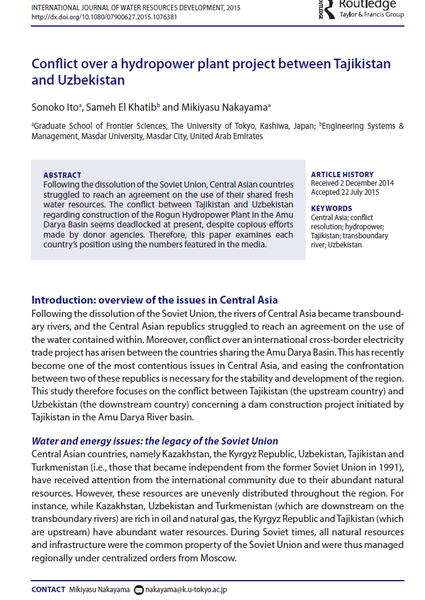
Year: 2014
Collections: Research Paper
Topics: Water, Transboundary Water Resources, Hydropower
Authors: Sonoko Ito, Sameh El Khatib, Mikiyasu Nakayama
Countries: Uzbekistan, Tajikistan
Source: International Journal of Water Resources Development
Following the dissolution of the Soviet Union, Central Asian countries struggled to reach an agreement on the use of their shared fresh water resources. The conflict between Tajikistan and Uzbekistan regarding construction of the Rogun Hydropower Plant in the Amu Darya Basin seems deadlocked at present, despite copious efforts made by donor agencies. Therefore, this paper examines each country’s position using the numbers featured in the media.
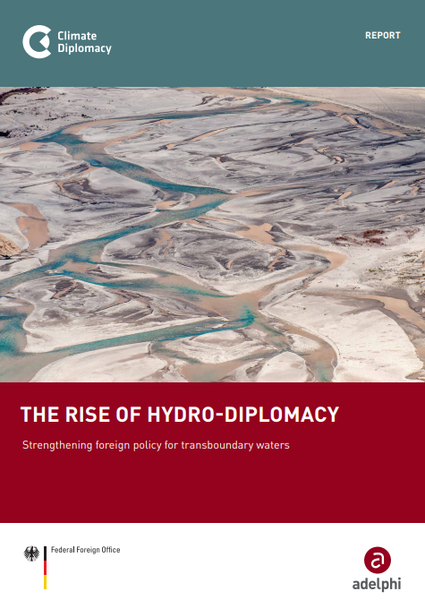
Year: 2014
Collections: Scientific Publications, Reports, Review article
Topics: Water diplomacy, Water, Water law, Water governance
Authors: Benjamin Pohl, et al.
Countries:
Source: Adelphi
Water is a fundamental precondition for human life. No substitute for freshwater exists, and it is scarce in many regions. Simultaneously, much of it transcends state borders via shared river and lake basins or groundwater aquifers. The resulting political, economic, social and environmental interdependencies give water resources the crucial potential to either foster cooperation or exacerbate conflict. The significance of access to water is growing as demographic and economic drivers as well as deteriorating water quality interact with climate change that will regionally increase water scarcity and variability.
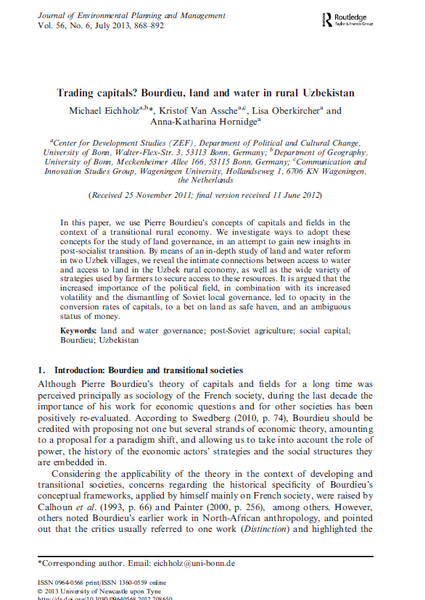
Year: 2013
Collections: Research Paper
Topics: Water, Water governance
Authors: Michael Eichholz, Kristof Van Assche, Lisa Oberkircher, Anna-Katharina Hornidge
Countries: Uzbekistan
Source: Journal of Environmental Planning and Management
This article analyzes the governance of land and water resources in rural Uzbekistan through the lens of Pierre Bourdieu’s sociological theory. The authors explore how farmers adapt to post-socialist reforms and successive waves of land consolidation by relying on different forms of capital, including social, political, and symbolic capital. The study demonstrates that, in the absence of an open market and transparent rules, access to resources becomes the outcome of continuous negotiations and exchanges of favors. Under conditions of high uncertainty, social networks and proximity to political authorities prove to be more important than direct financial investments. As a result, the rural economy is transformed into a complex system of personal arrangements, where the survival and success of farming households depend on farmers’ ability to convert their informal assets into actual access to land and water resources.
For questions about cooperation, please contact us at: