

Year: 2013
Collections:
Topics: Transboundary cooperation, Hydropower, Hydropolitics Irrigation,
Authors: Shlomi Dinar
Countries:
Source: Eurasian Geography and Economics
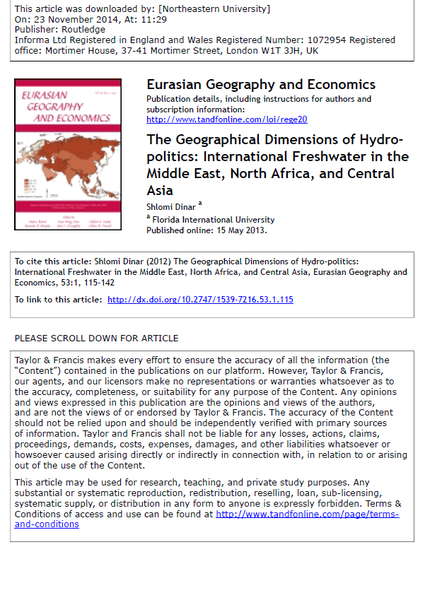
The article focuses on the role of geography and the relative power of states in international hydropolitics. The author analyzes how a country’s position within a river basin — upstream or downstream — affects its ability to participate in water negotiations. It is often assumed that a state with greater military and economic power can dictate the terms of water allocation. However, the author shows that geographical location is also an important source of power. Even a weaker state, if it is located upstream, can influence the water regime and challenge the existing status quo.
Year: 2013
Collections: Research Paper
Topics: Water, Water governance
Authors: Michael Eichholz, Kristof Van Assche, Lisa Oberkircher, Anna-Katharina Hornidge
Countries: Uzbekistan
Source: Journal of Environmental Planning and Management
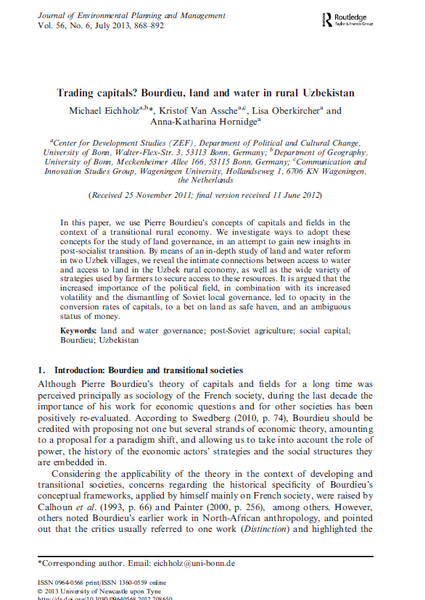
This article analyzes the governance of land and water resources in rural Uzbekistan through the lens of Pierre Bourdieu’s sociological theory. The authors explore how farmers adapt to post-socialist reforms and successive waves of land consolidation by relying on different forms of capital, including social, political, and symbolic capital. The study demonstrates that, in the absence of an open market and transparent rules, access to resources becomes the outcome of continuous negotiations and exchanges of favors. Under conditions of high uncertainty, social networks and proximity to political authorities prove to be more important than direct financial investments. As a result, the rural economy is transformed into a complex system of personal arrangements, where the survival and success of farming households depend on farmers’ ability to convert their informal assets into actual access to land and water resources.
Year: 2013
Collections: Research Paper
Topics: Water, IWRM, Transboundary Water Resources
Authors: Shokhrukh-Mirzo Jalilov, Saud A. Amer, Frank A. Ward
Countries:
Source: Eurasian Geography and Economics
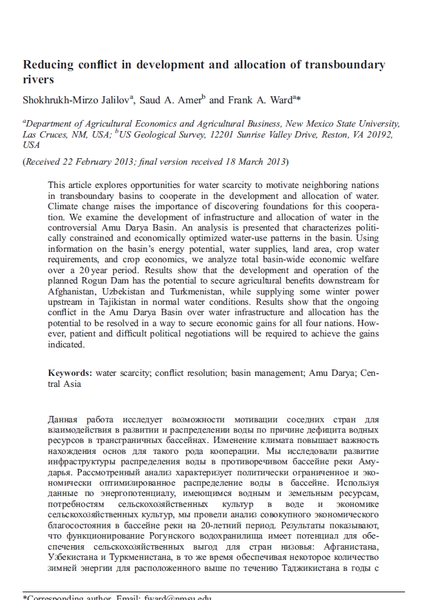
This article explores opportunities for water scarcity to motivate neighboring nations in transboundary basins to cooperate in the development and allocation of water. Climate change raises the importance of discovering foundations for this cooperation. The authors examine the development of infrastructure and allocation of water in the controversial Amu Darya Basin.
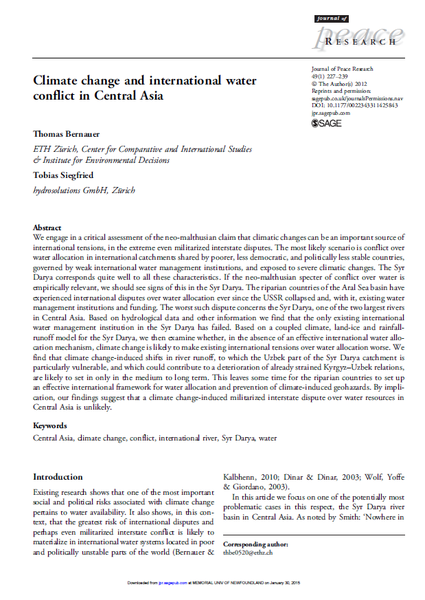
Year: 2012
Collections:
Topics: Water, Climate, NEXUS, Hydropolitics
Authors: Thomas Bernauer, Tobias Siegfried
Countries: Kazakhstan, Kyrgyzstan, Uzbekistan, Tajikistan
Source: Journal of Peace Research
The authors engage in a critical assessment of the neo-malthusian claim that climatic changes can be an important source of international tensions, in the extreme even militarized interstate disputes.
Year: 2012
Collections: Books
Topics: Water
Authors: Зеринг Дженнифер, Дибольд Альфред
Countries: Kazakhstan
Source:
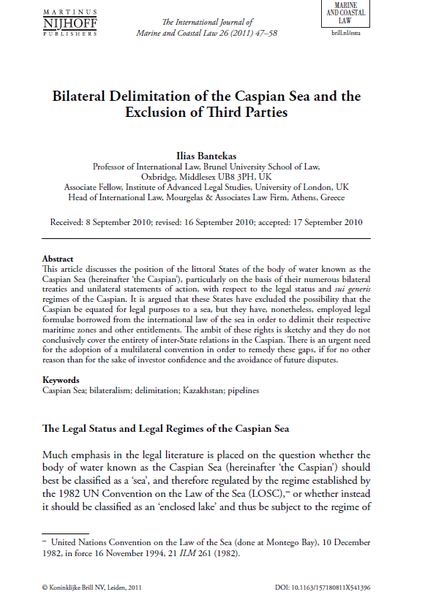
Year: 2010
Collections: Research Paper
Topics: Water, Water law, Water diplomacy, Transboundary Water Resources, Transboundary cooperation
Authors: Ilias Bantekas
Countries:
Source: The International Journal of Marine and Coastal Law
This article discusses the position of the littoral States of the body of water known as the Caspian Sea (hereinafter ‘the Caspian’), particularly on the basis of their numerous bilateral treaties and unilateral statements of action, with respect to the legal status and sui generis regimes of the Caspian.
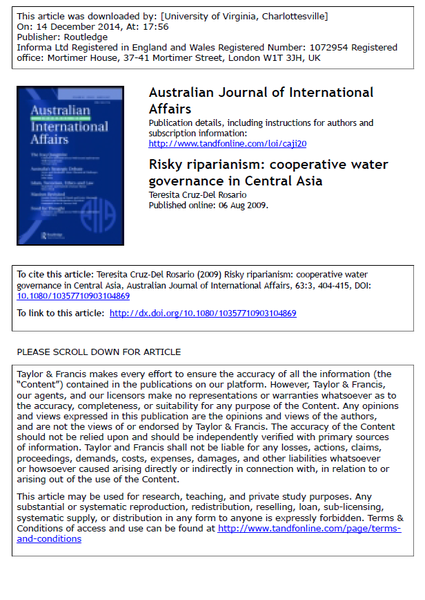
Year: 2009
Collections: Research Paper
Topics: Water, IWRM, Transboundary Water Resources, Transboundary cooperation
Authors: Teresita Cruz-Del Rosario
Countries:
Source: Australian Journal of International Affairs
The article examines the challenges of cooperative management of transboundary water resources in Central Asia. The author analyzes water relations among Kazakhstan, Kyrgyzstan, Tajikistan, Turkmenistan, and Uzbekistan through Ulrich Beck’s concept of “risk society.” The article argues that water scarcity, the transboundary nature of the Amu Darya and Syr Darya rivers, the Soviet legacy of centralized water management, artificial borders, and ethnic tensions create significant risks for regional stability.
Year: 2008
Collections: Conferences
Topics: IWRM, Water governance, Transboundary Water Resources, Transboundary cooperation
Authors: Mikhail Khankhasayev, Steven Leitman
Countries:
Source: Transboundary Water Resources: A Foundation for Regional Stability in Central Asia
This paper summarizes the main results of the NATO CCMS Pilot Study Meeting on Transboundary Water Management Issues in the United States & Central Asia (8–10 March 2005, Tallahassee, Florida). The structure of the meeting was focused on comparing how major transboundary water sharing conflicts in the United States (like the ACF conflict) have been managed toward the goal of equitable conflict resolution among the competing jurisdictions with similar conflicts in the Central Asian region.
Year: 2008
Collections: Books
Topics: Water, Sustainable Development, IWRM, Water diplomacy, Transboundary Water Resources, Water Security, Transboundary cooperation, Hydropolitics
Authors: Thomas Bernauer, Tobias Siegfried
Countries:
Source:
This book chapter examines the compliance and actual performance of an international water agreement in the Naryn/Syr Darya Basin in Central Asia. The authors analyze the 1998 agreement, which was designed to regulate the operation of the Toktogul Reservoir by balancing Kyrgyzstan’s need for winter hydropower production with Uzbekistan’s and Kazakhstan’s need for summer irrigation water. The main argument of the article is that formal compliance with an agreement does not necessarily mean that the agreement is effective in solving the real water allocation problem. Using the policy performance metric (PER), the authors show that although compliance with the agreement was relatively high, its actual performance was low and highly variable. The article concludes that the existing water management system in the Naryn/Syr Darya Basin requires urgent institutional reform.
Year: 2000
Collections:
Topics: Water, Water diplomacy, Transboundary Water Resources, Transboundary cooperation, Hydropolitics
Authors: Bertram I. Spector
Countries:
Source: International Negotiation
Recent research has focused mainly on factors linking environmental change or stress to violent conflict, while less attention has been paid to conditions that promote cooperation and negotiation. This study presents preliminary findings on environmental, social, and economic indicators that may create favourable conditions for cooperative water resource agreements. The results suggest that inequality among riparian states across physical, economic, and social dimensions can, unexpectedly, facilitate the negotiation of international and regional agreements on shared water resources.
For questions about cooperation, please contact us at: