

Год: 2023
Разделы: Научные публикации, Обзорная статья
Темы: Вода, Водная дипломатия
Авторы: Wondwosen Michago Seide, Emanuele Fantini
Страны:
Источник: Water Alternatives 16(3): 912-929
This paper aims to foreground the importance of emotions in water diplomacy in general and in Nile water diplomacy in particular. Water diplomacy does not operate from a clean slate, but in a socio-hydropolitically mediated context which is, in turn, imbued with emotions. The existing water diplomacy approach primarily operates with the assumption that the riparian state is a rational actor. However, we argue that emotions have underpinned water diplomacy, including the ongoing Nile negotiations. These emotions are neither acknowledged nor negotiated but are dismissed as irrationality in both the theoretical understanding and practice of water diplomacy.
Год: 2018
Разделы: Научные публикации
Темы: Вода
Авторы: Thevs Niels, Aliev Kumar, Strenge Eva, Eraaliev Maksat, Lang Petra, Baibagysov Azim
Страны: Казахстан
Источник: Central Asian Journal of Water Research
Год: 2021
Разделы: Научные публикации, Обзорная статья
Темы: Вода, Водная дипломатия
Авторы: Juho Haapala, Marko Keskinen, Erik Salminen
Страны:
Источник: Journal of Hydrology
In this article, we seek to contribute to the practice of water diplomacy by introducing a step-wise Water Diplomacy Paths approach for analysing different water diplomacy contexts and related water diplomacy actions. To facilitate this, we recognise five key aspects for water diplomacy (Political; Preventive; Integrative; Cooperative; Technical) and propose a general definition for water diplomacy. We also discuss the possible distinctions between the related concepts of water diplomacy and transboundary water cooperation. The use of the Water Diplomacy Paths approach is demonstrated with brief case studies focusing on Central Asia, the Mekong Region, and the Finnish-Russian water cooperation. The work builds on an extensive literature review and comparative analysis of water diplomacy approaches as well as on a series of workshops and interviews among selected water diplomacy actors, including career diplomats.
Год: 2014
Разделы: Научные публикации, Доклады, Обзорная статья
Темы: Водная дипломатия, Вода, Водное законодательство, Стратегическое управление водными ресурсами
Авторы: Benjamin Pohl, et al.
Страны:
Источник: Adelphi
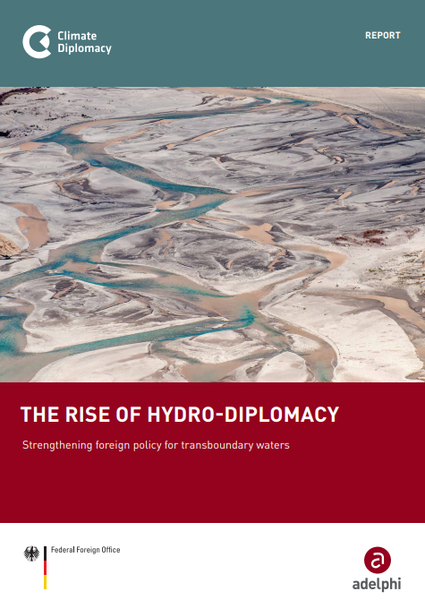
Water is a fundamental precondition for human life. No substitute for freshwater exists, and it is scarce in many regions. Simultaneously, much of it transcends state borders via shared river and lake basins or groundwater aquifers. The resulting political, economic, social and environmental interdependencies give water resources the crucial potential to either foster cooperation or exacerbate conflict. The significance of access to water is growing as demographic and economic drivers as well as deteriorating water quality interact with climate change that will regionally increase water scarcity and variability.
Год: 2020
Разделы: Научные публикации, Обзорная статья
Темы: Вода, Стратегическое управление водными ресурсами Водная дипломатия,
Авторы: et al., Margaret O. Wilder
Страны:
Источник: Environmental Science and Policy
The United States and Mexico have engaged in hydrodiplomacy—a practice of transboundary water management that blends water diplomacy and science diplomacy–for more than 75 years, since the adoption of the Treaty of 1944 and the creation of the International Boundary and Water Commission. We examine six major turning points in U.S.-Mexico hydrodiplomacy to ascertain the key factors in the region’s history of resolving transboundary water issues. We find that recognized adaptive governance indicators—such as social learning, sustained relationships, flexible governance mechanisms, and state and non-state networks are essential elements of hydrodiplomacy. Our research suggests that robust and foundational institutions comprise another key indicator of adaptive governance specifically in transboundary contexts. A commitment to both science and diplomacy have been important components underlying the effectiveness of hydrodiplomacy in the border region. Binational networks involving diverse state and non-state actors at multiple scales have increasingly played a pivotal role in shaping desirable hydrodiplomatic outcomes in the region.
Год: 2013
Разделы: Исследовательская работа
Темы: Вода, ИУВР, Трансграничные водные ресурсы
Авторы: Shokhrukh-Mirzo Jalilov, Saud A. Amer, Frank A. Ward
Страны:
Источник: Eurasian Geography and Economics
This article explores opportunities for water scarcity to motivate neighboring nations in transboundary basins to cooperate in the development and allocation of water. Climate change raises the importance of discovering foundations for this cooperation. The authors examine the development of infrastructure and allocation of water in the controversial Amu Darya Basin.
Год: 2017
Разделы: Исследовательская работа
Темы: Вода, Стратегическое управление водными ресурсами, Трансграничные водные ресурсы, Трансграничное сотрудничество, Гидрополитика
Авторы: Sarah Acquah, Frank A. Ward
Страны:
Источник: Water Resources Management
Afghanistan contributes water supplies to Iran, Pakistan, Tajikistan, Turkmenistan, and Uzbekistan. However, with the exception of the Helmand Basin, Afghanistan has negotiated transboundary water sharing agreements with no downstream country. This paper describes a constrained optimization framework to minimize economic costs within each of nine Afghan transboundary basins of adapting to potential water sharing agreements.
Год: 2017
Разделы: Исследовательская работа
Темы: Вода, Водная безопасность
Авторы: Frederike Klümper, Thomas Herzfeld, Insa Theesfeld
Страны: Таджикистан
Источник: Water
This scientific article examines the concept of water security in the irrigation sector of Tajikistan at the individual farm level. The authors develop a comprehensive Water Security Index that incorporates hydrological, governance, and hybrid dimensions to assess the actual availability and accessibility of water resources. The study reveals that, despite the physical abundance of water, weak governance and institutional barriers are the primary sources of water insecurity. Based on a survey of 399 farming households, the authors establish a typology of farms, demonstrating that large and small producers face fundamentally different water-related challenges. The findings show that effective governance can compensate for infrastructure deficiencies, thereby enhancing the resilience of agricultural production. The article concludes by emphasizing the need to shift from broad national water security indicators toward targeted support for local water distribution and management systems.
По всем вопросам сотрудничества обращайтесь по эл.адресу или телефону: