
Year: 2022
Collections: Research Paper
Topics: Water, Sustainable Development, NEXUS, Water governance, Transboundary Water Resources
Authors: Ahmad Hamidov, Katrin Daedlow, Heidi Webber, Hussam Hussein, Ilhom Abdurahmanov, Aleksandr Dolidudko, Ali Yawar Seerat, Umida Solieva, Tesfaye Woldeyohanes, Katharina Helming
Countries:
Source: Ecology and Society
This article focuses on the operationalization of the Water–Energy–Food (WEF) Nexus concept as a framework for promoting sustainable development in Central Asia. The researchers examine the application of the Sustainability Impact Assessment (SIA) protocol as a tool for interdisciplinary analysis of five different environmental systems across the region. The findings demonstrate that a systems-based approach helps experts identify critical trade-offs between water resource management, energy production, and soil conservation. The authors emphasize that the SIA framework is effective in addressing interdisciplinary complexity; however, it requires further development in areas related to ethics and stakeholder engagement. Overall, the study highlights that regional cooperation and the integration of scientific approaches are essential for mitigating the impacts of environmental degradation, including challenges such as the desiccation of the Aral Sea. The article therefore provides a methodological foundation for translating theoretical nexus concepts into practical strategies for natural resource management and sustainable development.
Year: 2023
Collections: Research Paper
Topics: Water, Green business
Authors: Hutson N., Taganova J.
Countries: Kazakhstan
Source: Central Asian Journal of Water Research
Recent geopolitical events have thrust the Caspian region into a time of unparalleled opportunity. Specifically, the Middle Corridor (“MC”) has been presented as a potential savior for trans-Eurasian commerce. At the same time, its success relies on a sea that is in an ecologically precarious state.
Year: 2022
Collections: Policy Briefs
Topics: Energy
Authors: Nurbossynova Saltanat, Idrissov Marat
Countries: Kazakhstan, Kyrgyzstan, Uzbekistan, Tajikistan, Turkmenistan
Source:
Year: 2022
Collections: Scientific Publications
Topics: Sustainable Development
Authors: Idrissov Marat, Yerzakovich Yelena, Dienel Hans-Liudger, Assmann Tom
Countries: Kazakhstan
Source:
Year: 2022
Collections: Research Paper
Topics: Water, Sustainable Development, NEXUS, Water governance, Transboundary Water Resources
Authors: Ahmad Hamidov, Katrin Daedlow, Heidi Webber, Hussam Hussein, Ilhom Abdurahmanov, Aleksandr Dolidudko, Ali Yawar Seerat, Umida Solieva, Tesfaye Woldeyohanes, Katharina Helming
Countries:
Source: Ecology and Society
This article focuses on the operationalization of the Water–Energy–Food (WEF) Nexus concept as a framework for promoting sustainable development in Central Asia. The researchers examine the application of the Sustainability Impact Assessment (SIA) protocol as a tool for interdisciplinary analysis of five different environmental systems across the region. The findings demonstrate that a systems-based approach helps experts identify critical trade-offs between water resource management, energy production, and soil conservation. The authors emphasize that the SIA framework is effective in addressing interdisciplinary complexity; however, it requires further development in areas related to ethics and stakeholder engagement. Overall, the study highlights that regional cooperation and the integration of scientific approaches are essential for mitigating the impacts of environmental degradation, including challenges such as the desiccation of the Aral Sea. The article therefore provides a methodological foundation for translating theoretical nexus concepts into practical strategies for natural resource management and sustainable development.
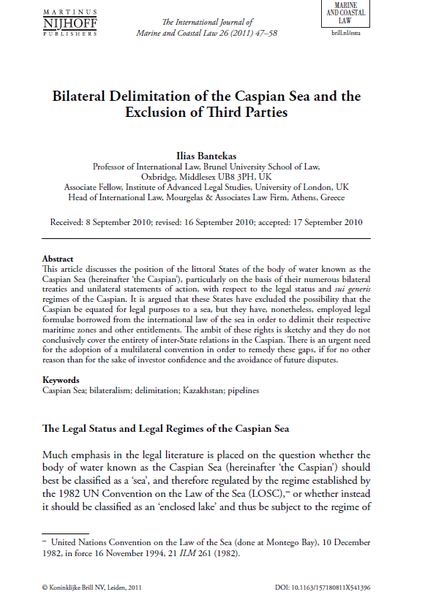
Year: 2010
Collections: Research Paper
Topics: Water, Water law, Water diplomacy, Transboundary Water Resources, Transboundary cooperation
Authors: Ilias Bantekas
Countries:
Source: The International Journal of Marine and Coastal Law
This article discusses the position of the littoral States of the body of water known as the Caspian Sea (hereinafter ‘the Caspian’), particularly on the basis of their numerous bilateral treaties and unilateral statements of action, with respect to the legal status and sui generis regimes of the Caspian.
Year: 2021
Collections: Scientific Publications
Topics: Agriculture
Authors: Salmukhanbetova Zh.K., Imanalinova A. A., Dimeyeva L. A., Zverev N.E.
Countries: Kazakhstan
Year: 2022
Collections: Policy Briefs
Topics: Water, Gender
Authors: Tankibayeva Aliya, Bouman-Dentener Alice, Ingraham Rachel Fisher
Countries: Kazakhstan, Kyrgyzstan, Uzbekistan, Tajikistan, Turkmenistan, Afghanistan
Source:
● Five Central Asian countries have the right momentum to build genderinclusive WASH
● Transition can accelerate with investments into safe, resource-efficient, scale-appropriate and modern supply and sanitation infrastructure, technologies, and services
● Inclusive WASH systems are resilient when women take an active role in policy decisions at all levels and implementation
Year: 2017
Collections: Research Paper
Topics: Water, Water Security
Authors: Frederike Klümper, Thomas Herzfeld, Insa Theesfeld
Countries: Tajikistan
Source: Water
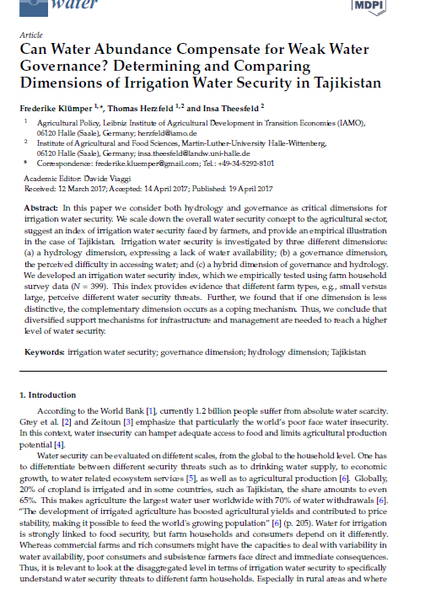
This scientific article examines the concept of water security in the irrigation sector of Tajikistan at the individual farm level. The authors develop a comprehensive Water Security Index that incorporates hydrological, governance, and hybrid dimensions to assess the actual availability and accessibility of water resources. The study reveals that, despite the physical abundance of water, weak governance and institutional barriers are the primary sources of water insecurity. Based on a survey of 399 farming households, the authors establish a typology of farms, demonstrating that large and small producers face fundamentally different water-related challenges. The findings show that effective governance can compensate for infrastructure deficiencies, thereby enhancing the resilience of agricultural production. The article concludes by emphasizing the need to shift from broad national water security indicators toward targeted support for local water distribution and management systems.
Year: 2018
Collections: Research Paper
Topics: Water governance, IWRM, Transboundary cooperation Irrigation,
Authors: Iroda Amirova, Martin Petrick, Nodir Djanibekov
Countries: Kazakhstan, Uzbekistan
Source: World Development
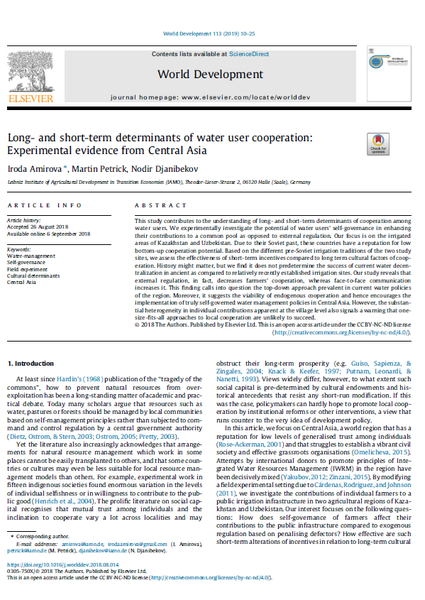
This study contributes to the understanding of long- and short-term determinants of cooperation among water users. We experimentally investigate the potential of water users’ self-governance in enhancing their contributions to a common pool as opposed to external regulation. Our focus is on the irrigated areas of Kazakhstan and Uzbekistan.
Year: 2023
Collections: Scientific Publications
Topics: Climate
Authors: Kulikov M., Shibkov E., Isaev E., Azarov A., Sidle R.
Countries: Kyrgyzstan
Source: Central Asian Journal of Sustainability and Climate Research
Understanding forest phenology is essential for monitoring global carbon budgets and managing vegetation resources in a changing climate. In southern Kyrgyzstan, walnut and wild apple trees dominate the forest landscape. These forests contain unique genetic diversity and offer potential for the development of climate-resilient crop varieties. They also support local communities through activities such as grazing, firewood collection, and fruit harvesting. However, these practices pose a threat to natural regeneration. Climate change exacerbates these challenges by altering their ecological niche. Despite this, few studies have examined forest phenology and its relationship to climate in Kyrgyzstan.
Year: 2024
Collections: Scientific Publications
Topics: Climate
Authors: Isaev E., Murata Akihiko, Shin Fukui, Roy C. Sidle
Countries: Kazakhstan, Kyrgyzstan, Uzbekistan, Tajikistan, Turkmenistan, Afghanistan
Source: https://water-ca.org/
Climate change poses various challenges for agriculture and water management practices in Central Asia (CA). Central to these challenges are cryosphere dynamics, fragile mountain ecosystems, and ongoing natural hazards that highlight the need for robust projections of regional climate change. For the first time, dynamic downscaling was conducted in Central Asia at a spatial resolution of 5 km.
For questions about cooperation, please contact us at: