
Year: 2024
Collections: Scientific Publications
Topics: Water
Authors: Azamat Madibekov, Laura Ismukhanova, Askhat Zhadi, Botakoz Sultanbekova, Serik Zhumatayev, Alibek Karimov, Sergei Fokin
Countries: Kazakhstan
Source: https://water-ca.org
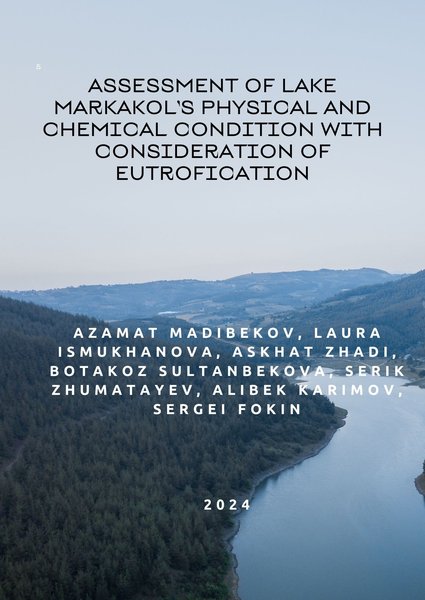
The study was conducted in 2023 and comprised a comparative assessment of the state of Lake Markakol’s aquatic ecosystems in surface and bottom water strata. The analysis of bottom water temperatures showed correlation between this parameter and dissolved oxygen concentrations, indicating that pollution caused by organic impurities leads to lake eutrophication, in turn, pro-pelling the extinction of aquatic life. Although the main water physicochemical parameters of Markakol Lake correspond to the oligotrophic type, the shifts in dissolved oxygen and phos-phate content, as well as growth of aquatic vegetation indicate its transition to the mesotrophic type. Higher phosphate content in water is a consequence of pollution disturbing the biological balance, as well as stimulating the reservoir’s eutrophication and increased biological productivity, i.e. algal bloom. In addition, phosphate ions serve an informative indicator of Hazard Class 3 (organoleptically hazardous) anthropogenic pollution. Based on the correlation factor (r), two statistical models were considered for the target lake: 1) Water Pollution: nutri-ent concentrations depending on surface and bottom water temperatures (Model 1); and 2) changes in Water Pollution Indices (biogenic, heavy metals, mean) because of air temperature growth due to global warming of 0.25°C/decade (Model 2).
Year: 2022
Collections: Scientific Publications
Topics: Sustainable Development
Authors: Idrissov Marat, Yerzakovich Yelena, Dienel Hans-Liudger, Assmann Tom
Countries: Kazakhstan
Source:
Year: 2021
Collections: Scientific Publications
Topics: Water
Authors: Assubayeva A.
Countries: Kazakhstan, Kyrgyzstan, Uzbekistan, Tajikistan, Turkmenistan
Year: 2025
Collections: Scientific Publications
Topics: Water, IWRM
Authors: Gafurov A., Ziganshina Dinara, Assubayeva A., Nodir Djanibekov, Abdullaev Iskandar, Bobojonov Ihtiyor, Dombrowsky Ines, Hamidov Ahmad, Herrfahrdt-Pähle Elke, Janusz-Pawletta Barbara, Ishangulyyev Rovshen, Kasymov Ulan, Mirkasimov Bakhrom, Petrick Martin, Strobehn Katrin
Countries: Kazakhstan, Kyrgyzstan, Uzbekistan, Tajikistan, Turkmenistan
Source: water-ca.org
Political tensions over water management in the Central Asia region have intensified since the Soviet era, as ecological issues like the drying Aral Sea and seasonal hydropower disruptions impact downstream countries. The paper discusses the region’s water governance challenges, including climate-induced uncertainties, water resource demands, and the limited capacity of local research institutions. While Central Asia’s governments have initiated reforms, including new infrastructure and agreements, resilience in water management remains underdeveloped. The paper also explores the role of higher education institutions in fostering capacity-building for sustainable governance, emphasizing the need for local expertise and regional collaboration. The proposed establishment of a Central Asian water research platform aims to enhance science-policy integration, promote sustainable water governance, and support informed regional cooperation on transboundary water issues.
Year: 2017
Collections: Scientific Publications
Topics: Water, Climate
Authors: Gafurov A., Sagintayev J.M., Atanov Serikzhan
Countries: Kazakhstan, Kyrgyzstan, Uzbekistan, Tajikistan, Turkmenistan
Year: 2018
Collections: Scientific Publications
Topics: Water
Authors: Sadeqinazhad Fahima, Atef Said Shakib, Amatya Devendra M.
Countries: Afghanistan
Year: 2020
Collections: Research Paper
Topics: Water
Authors: Krupa E., Barinova S., Romanova S., Aubakirova M., Ainabaeva N.
Countries: Kazakhstan
Year: 2024
Collections: Research Paper
Topics: IWRM, Water law, Water diplomacy, Transboundary Water Resources, Transboundary cooperation
Authors: Ayşegül Kibaroğlu
Countries:
Source: Theorizing Transboundary Waters in International Relations
Water diplomacy encompasses the processes and institutions through which the national interests and identities of sovereign states are represented to one another. It is enshrined in international law, which states use to explain and justify their policies to concerned actors in the international system. States mostly prefer traditional tools of water diplomacy such as negotiation and mediation to resolve disputes in transboundary river basins.
Year: 2024
Collections: Scientific Publications
Topics: Water
Authors: Azamat Madibekov, Laura Ismukhanova, Askhat Zhadi, Botakoz Sultanbekova, Serik Zhumatayev, Alibek Karimov, Sergei Fokin
Countries: Kazakhstan
Source: https://water-ca.org
The study was conducted in 2023 and comprised a comparative assessment of the state of Lake Markakol’s aquatic ecosystems in surface and bottom water strata. The analysis of bottom water temperatures showed correlation between this parameter and dissolved oxygen concentrations, indicating that pollution caused by organic impurities leads to lake eutrophication, in turn, pro-pelling the extinction of aquatic life. Although the main water physicochemical parameters of Markakol Lake correspond to the oligotrophic type, the shifts in dissolved oxygen and phos-phate content, as well as growth of aquatic vegetation indicate its transition to the mesotrophic type. Higher phosphate content in water is a consequence of pollution disturbing the biological balance, as well as stimulating the reservoir’s eutrophication and increased biological productivity, i.e. algal bloom. In addition, phosphate ions serve an informative indicator of Hazard Class 3 (organoleptically hazardous) anthropogenic pollution. Based on the correlation factor (r), two statistical models were considered for the target lake: 1) Water Pollution: nutri-ent concentrations depending on surface and bottom water temperatures (Model 1); and 2) changes in Water Pollution Indices (biogenic, heavy metals, mean) because of air temperature growth due to global warming of 0.25°C/decade (Model 2).
Year: 2021
Collections: Research Paper
Topics: Irrigation
Authors: Mitusov A., Sultanbekova A.K., Sagintayev J.M., Azami A.
Countries: Kazakhstan
Year: 2020
Collections: Research Paper
Topics: Water
Authors: Azami A., Sagin J., Sadat S. H., Hejran H.
Countries: Afghanistan
Year: 2023
Collections: Scientific Publications
Topics: Climate
Authors: Kulikov M., Shibkov E., Isaev E., Azarov A., Sidle R.
Countries: Kyrgyzstan
Source: Central Asian Journal of Sustainability and Climate Research
Understanding forest phenology is essential for monitoring global carbon budgets and managing vegetation resources in a changing climate. In southern Kyrgyzstan, walnut and wild apple trees dominate the forest landscape. These forests contain unique genetic diversity and offer potential for the development of climate-resilient crop varieties. They also support local communities through activities such as grazing, firewood collection, and fruit harvesting. However, these practices pose a threat to natural regeneration. Climate change exacerbates these challenges by altering their ecological niche. Despite this, few studies have examined forest phenology and its relationship to climate in Kyrgyzstan.
For questions about cooperation, please contact us at: