
Year: 2018
Collections: Scientific Publications
Topics: Water
Authors: Thevs Niels, Aliev Kumar, Rouzi Ahemaitijiang, Abudushalike Nuerbayi
Countries: China
Year: 2024
Collections: Scientific Publications
Topics: Climate
Authors: Isaev E., Murata Akihiko, Shin Fukui, Roy C. Sidle
Countries: Kazakhstan, Kyrgyzstan, Uzbekistan, Tajikistan, Turkmenistan, Afghanistan
Source: https://water-ca.org/
Climate change poses various challenges for agriculture and water management practices in Central Asia (CA). Central to these challenges are cryosphere dynamics, fragile mountain ecosystems, and ongoing natural hazards that highlight the need for robust projections of regional climate change. For the first time, dynamic downscaling was conducted in Central Asia at a spatial resolution of 5 km.
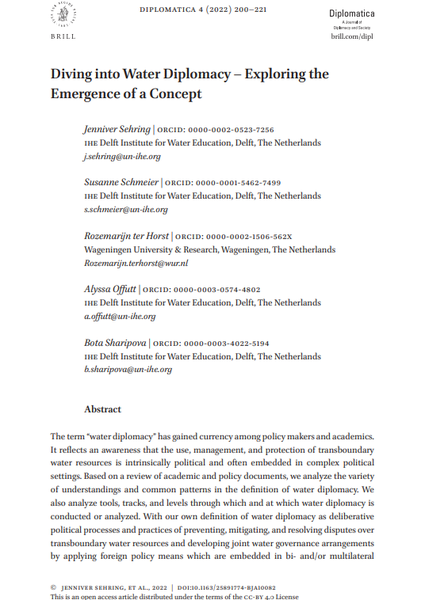
Year: 2022
Collections: Scientific Publications, Review article
Topics: Water, Water governance Water diplomacy,
Authors: Bota Sharipova, Susanne Schmeier, Rozemarijn ter Horst, Alyssa Offutt, Jenniver Sehring
Countries:
Source: Diplomatica, 4(2), 200-221
Based on a review of academic and policy documents, we analyze the variety of understandings and common patterns in the definition of water diplomacy. We also analyze tools, tracks, and levels through which and at which water diplomacy is conducted or analyzed.
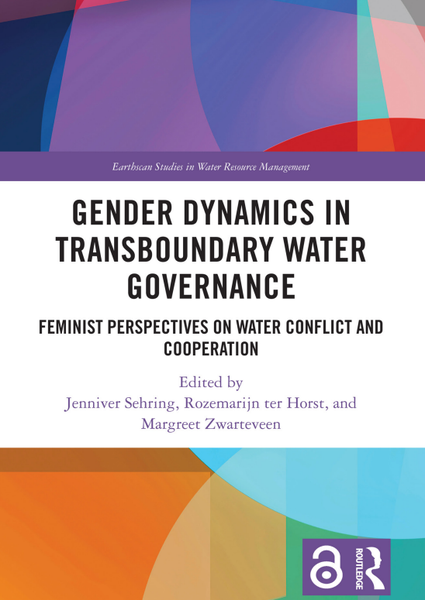
Year: 2023
Collections: Scientific Publications, Books
Topics: Water diplomacy, Water, Gender, Water governance
Authors: Rozemarijn ter Horst, Jenniver Sehring, Margreet Zwarteveen
Countries:
Source: Routledge. Taylor & Francis
This volume assesses the nexus of gender and transboundary water governance, containing empirical case studies, discourse analyses, practitioners’ accounts, and theoretical refections.
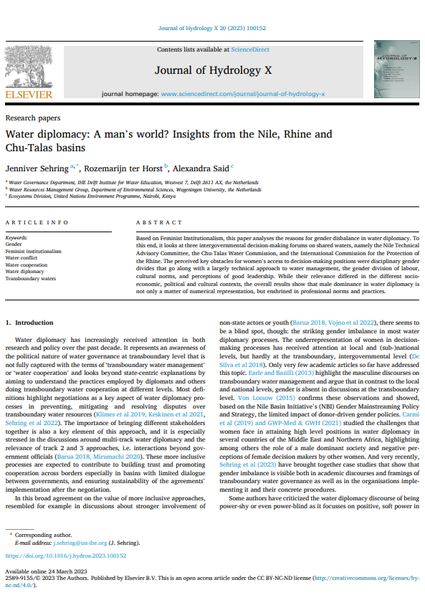
Year: 2023
Collections: Scientific Publications, Review article
Topics: Water, Water governance Water diplomacy,
Authors: Rozemarijn ter Horst, Jenniver Sehring, Alexandra Said
Countries:
Source: Journal of Hydrology X
Based on Feminist Institutionalism, this paper analyses the reasons for gender disbalance in water diplomacy. To this end, it looks at three intergovernmental decision-making forums on shared waters, namely the Nile Technical Advisory Committee, the Chu-Talas Water Commission, and the International Commission for the Protection of the Rhine. The perceived key obstacles for women’s access to decision-making positions were disciplinary gender divides that go along with a largely technical approach to water management, the gender division of labour, cultural norms, and perceptions of good leadership. While their relevance differed in the different socioeconomic, political and cultural contexts, the overall results show that male dominance in water diplomacy is not only a matter of numerical representation, but enshrined in professional norms and practices.
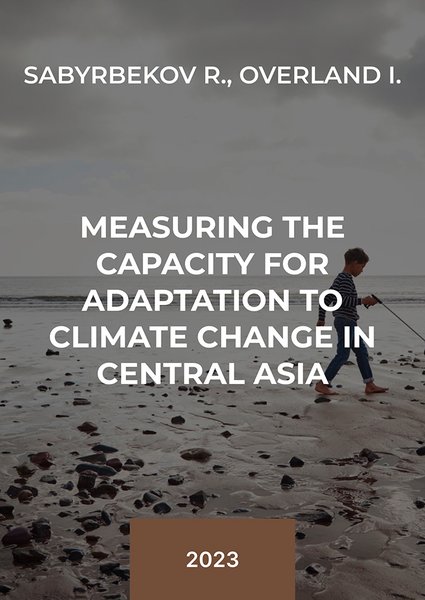
Year: 2023
Collections: Scientific Publications
Topics: Climate
Authors: Sabyrbekov R., Overland I.
Countries: Kazakhstan, Kyrgyzstan, Uzbekistan, Tajikistan, Turkmenistan
Source: Central Asian Journal of Sustainability and Climate Research
Climate change poses a formidable threat to the Central Asian region, exacerbating preexisting vulnerabilities and necessitating enhanced adaptation efforts. The economic and environmental costs of these changing climatic conditions are substantial, compelling governments to bolster their adaptive capacity. In this study, we employ the United Nations Framework Convention on Climate Change (UNFCCC) adaptation framework and high-quality data to quantitatively measure the capacities of the Central Asian countries to adapt to the impacts of climate change.
Year: 2020
Collections: Research Paper
Topics: Water
Authors: Azami A., Sagin J., Sadat S. H., Hejran H.
Countries: Afghanistan
Year: 2018
Collections: Scientific Publications
Topics: Water
Authors: Sadeqinazhad Fahima, Atef Said Shakib, Amatya Devendra M.
Countries: Afghanistan
![Manual_5.0_FINAL_12.3_3rd_edition[1]_Страница_001](/media/images/Manual_5.0_FINAL_12.3_3rd_edition1.2e16d0ba.fill-425x600.png)
Year: 2025
Collections: Manuals
Topics: Water, IWRM
Authors: Kogutenko Larissa, Safiya Asalbekova, Michael Walther
Countries: Kazakhstan, Kyrgyzstan, Uzbekistan, Tajikistan, Turkmenistan
Source: Journal of MOLARE Research Centre (MRC)
Why water monitoring and assessment are important?
Water quality assessment is one of the crucial scientific and practical analyses to identify the possibility of water consumption for different human needs and nature/ecosystem conservation for future generations. Water quality can be measured and monitored in rivers, springs, creeks, swamps, estuaries, wetlands and lakes what is called aquatic systems. Quality parameters, such as biological, chemical and physical indicators identify the combination of values that influence the composition of water. Monitoring and comparison of different water habitats (macro invertebrates) in biological monitoring provides an information of water quality and allows to make a quick assessment.
Year: 2020
Collections: Research Paper
Topics: Water
Authors: Azami A., Sagin J., Sadat S. H., Hejran H.
Countries: Afghanistan
Year: 2021
Collections: Research Paper
Topics: Irrigation
Authors: Mitusov A., Sultanbekova A.K., Sagintayev J.M., Azami A.
Countries: Kazakhstan
Year: 2017
Collections: Scientific Publications
Topics: Water, Climate
Authors: Sagintayev J.M., Kerimkulov Zhandos
Countries: Kazakhstan, Kyrgyzstan, Uzbekistan, Tajikistan, Turkmenistan
Year: 2017
Collections: Scientific Publications
Topics: Water, Climate
Authors: Gafurov A., Sagintayev J.M., Atanov Serikzhan
Countries: Kazakhstan, Kyrgyzstan, Uzbekistan, Tajikistan, Turkmenistan
Year: 2024
Collections: Scientific Publications
Topics: Water
Authors: Nematullah Fetrat, Ahmad Reza Rostayee, Sai Kala
Countries: Afghanistan
Source: https://water-ca.org
The article investigates certain low-cost filtering materials and their filtration efficiency for open well sources in terms of economic access to clean water in Anakapalle, a suburb of Visa-khapatnam, India, during the pre-monsoon period of 2022. The corresponding research aimed to study a selection of filter materials including coconut shell activated carbon, rice husk ash, manganese modified sand, and graphene oxide, as well as assess their performance against selected physico-chemical parameters of water. Considering the basic idea of slow sand and gravity-based filtration, a setup was arranged with a cartridge filled with layers of filtering materials and a ceramic candle filter. Adsorption turned out the most pronounced removal mechanism that took place when utilizing the aforementioned filter materials. The main focus of the study was to reduce pH, TDS, hardness, alkalinity, chlorides and iron content by applying dif-ferent filtration removal mechanisms. The study results show a significant drop in turbidity, pH, TDS and chlorides, and small reduction in hardness when coconut shell activated carbon and rice husk ash were used as filtration media. Whereas the chemically coated medium – manga-nese modified sand – demonstrated a considerable fall in iron concentrations, graphene oxide sand was observed to reduce alkalinity for any sample source.
For questions about cooperation, please contact us at: