
Year: 2017
Collections: Scientific Publications
Topics: Water
Authors: Shivareva Svetlana, Bulekbayeva Latifa
Countries: Kazakhstan, Kyrgyzstan
Year: 2013
Collections:
Topics: Transboundary cooperation, Hydropower, Hydropolitics Irrigation,
Authors: Shlomi Dinar
Countries:
Source: Eurasian Geography and Economics
The article focuses on the role of geography and the relative power of states in international hydropolitics. The author analyzes how a country’s position within a river basin — upstream or downstream — affects its ability to participate in water negotiations. It is often assumed that a state with greater military and economic power can dictate the terms of water allocation. However, the author shows that geographical location is also an important source of power. Even a weaker state, if it is located upstream, can influence the water regime and challenge the existing status quo.
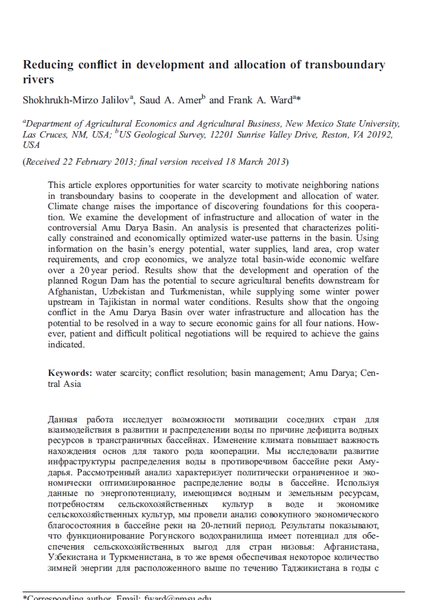
Year: 2013
Collections: Research Paper
Topics: Water, IWRM, Transboundary Water Resources
Authors: Shokhrukh-Mirzo Jalilov, Saud A. Amer, Frank A. Ward
Countries:
Source: Eurasian Geography and Economics
This article explores opportunities for water scarcity to motivate neighboring nations in transboundary basins to cooperate in the development and allocation of water. Climate change raises the importance of discovering foundations for this cooperation. The authors examine the development of infrastructure and allocation of water in the controversial Amu Darya Basin.
Year: 2017
Collections: Scientific Publications
Topics: Water, Climate
Authors: Klove B., Shokory Jamal Abdul Naser, Tsutsumi Jun-ichiro Giorgos, Yamada Hiroyuki
Countries: Afghanistan
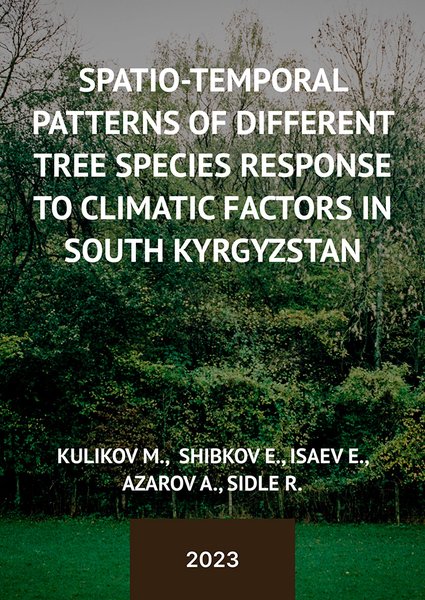
Year: 2023
Collections: Scientific Publications
Topics: Climate
Authors: Kulikov M., Shibkov E., Isaev E., Azarov A., Sidle R.
Countries: Kyrgyzstan
Source: Central Asian Journal of Sustainability and Climate Research
Understanding forest phenology is essential for monitoring global carbon budgets and managing vegetation resources in a changing climate. In southern Kyrgyzstan, walnut and wild apple trees dominate the forest landscape. These forests contain unique genetic diversity and offer potential for the development of climate-resilient crop varieties. They also support local communities through activities such as grazing, firewood collection, and fruit harvesting. However, these practices pose a threat to natural regeneration. Climate change exacerbates these challenges by altering their ecological niche. Despite this, few studies have examined forest phenology and its relationship to climate in Kyrgyzstan.

Year: 2024
Collections: Scientific Publications
Topics: Water, Climate
Authors: Aidar Zhumabaev, Hannah Schwedhelm, Beatrice Marti, Silvan Ragettli, Tobias Siegfried
Countries: Kazakhstan
Source: https://water-ca.org
The Badam River, a tributary to the Arys River located in the Syr Darya basin, is a crucial natural resource for ecological, social, and economic activities in the semi-arid region of southern Kazakhstan. The river basin is heavily influenced by manmade water infrastructure and faces water scarcity, particularly during summer, highlighting the importance of understanding its hydrological processes for effective water resource management. In this study, a semi-distributed conceptual hydrological model of the Badam River was implemented using the RS MINERVE hydrological software to evaluate the impacts of climate change on hydrology and to test the resilience of the water system. Connected HBV models were implemented for each of the hydrological response units that were defined as altitudinal zones. The hydrological model was calibrated using daily time steps between 1979 and 2011, and the resulting flow exceedance curves and hydrographs were used to assess the potential impacts of climate change on the basin, using CMIP6 precipitation and temperature scenarios. Future climate scenarios for the 2054 – 2064 period demonstrate that the peak discharge will be shifted to spring/late spring compared to the current early summer with no significant decrease in average discharge per day of the year. The insights gained from this hydrological-hydraulic model can be used to effectively manage the water system and inform future hydropower design decisions and serve as a blueprint for similar studies in the region and elsewhere.
Year: 2021
Collections:
Topics: Climate, Sustainable Development, IWRM, Water diplomacy, Transboundary Water Resources, Water Security
Authors: Soheila Zareie, Omid Bozorg‑Haddad, Hugo A. Loáiciga
Countries:
Source: Environment, Development and Sustainability
Diplomacy is the art and skill of managing international relations through negotiations between representatives of states or agencies. Water diplomacy is an innovative approach and strategic tool to resolve water issues at local and trans-boundary scales when water conflicts rise in sharing water resources. Complex water supply and sharing issues arise from the existence of multiple stakeholders such as agriculture, industry, urban and domestic users, environmental use, and others competing for scarce water. Water diplomacy may contribute to solving a variety of water conflicts and in this sense is a tool for sustainable water resources management.
Year: 2019
Collections: Research Paper
Topics: Water, Transboundary Water Resources, Transboundary cooperation, Hydropower
Authors: Sara McLaughlin Mitchell, Sojeong Lee
Countries:
Source: Journal of Peace Research
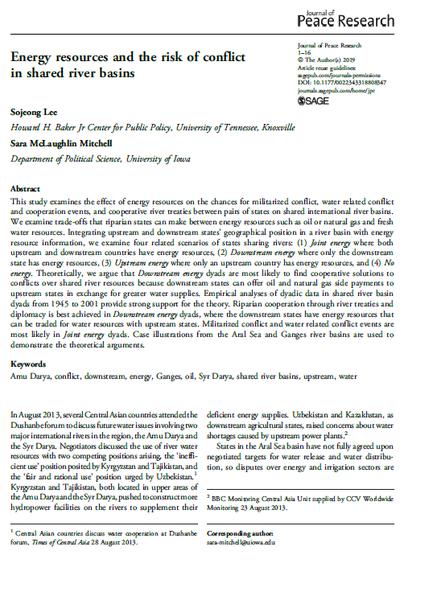
This study examines the effect of energy resources on the chances for militarized conflict, water related conflict and cooperation events, and cooperative river treaties between pairs of states on shared international river basins.
Year: 2020
Collections: Scientific Publications
Topics: Water
Authors: Hamdard M. H., Soliev I., Xiong L., Klove B.
Countries: Afghanistan
Year: 2020
Collections: Scientific Publications
Topics: Water
Authors: Hamdard M. H., Soliev I., Xiong L., Klove B.
Countries: Afghanistan
Source:
Year: 2025
Collections: Scientific Publications
Topics: Water, Energy, Agriculture
Authors: Hamidov Ahmad, Bobocholov Asliddin, Sonoko Dorothea Bellingrath-Kimura
Countries: Uzbekistan
Source: water-ca.org
The water, energy, and food (WEF) nexus is being promoted as a conceptual idea for achieving sustainable development, that describes the interconnections and interdependencies between those three sectors. The main objective of this article is to operationalize the WEF nexus concept in lift-irrigated areas of Uzbekistan through involving local stakeholders, to investigate the WEF nexus within the lift-irrigated agriculture of the Kashkadarya region, an area heavily reliant on the Karshi Canal system. The study is grounded in the urgent need for sustainable development, with a focus on enhancing intersectoral cooperation between water, energy, and food sectors. A case study methodology was employed, incorporating semi-structured interviews with experts, alongside local farmers and scientists. Data were analysed using the qualitative analysis software, Atlas.ti. The results indicate significant challenges to intersectoral cooperation in the WEF nexus, including lack of trust, communication barriers, differing priorities, and insufficient political will. However, the findings also highlight the potential benefits of improved cooperation, such as enhanced resource efficiency, reduced operational costs, and mitigated risks from environmental stressors like drought. The study concludes that, according to stakeholders’ opinions, while the WEF nexus presents critical opportunities for advancing sustainable development in Uzbekistan, substantial barriers must be addressed to realize these benefits. Recommendations include promoting sustainable agriculture to reduce water dependency, improving energy security by diversifying energy sources, and raising awareness of the WEF nexus’s importance. Furthermore, fostering stronger stakeholder cooperation is crucial for achieving Uzbekistan’s Sustainable Development Goals (SDGs) by 2030.
For questions about cooperation, please contact us at: