
Year: 2012
Collections:
Topics: Water, Climate, NEXUS, Hydropolitics
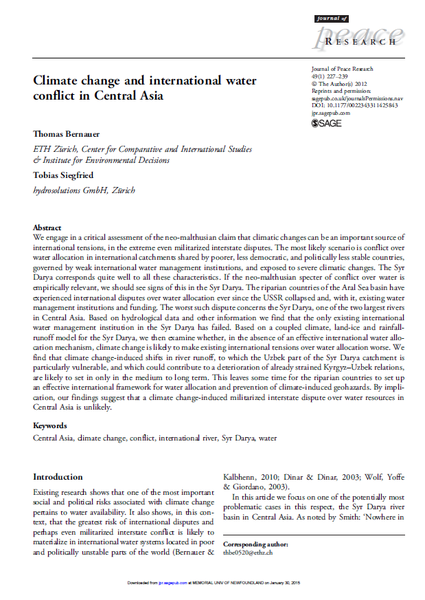
Authors: Thomas Bernauer, Tobias Siegfried
Countries: Kazakhstan, Kyrgyzstan, Uzbekistan, Tajikistan
Source: Journal of Peace Research
The authors engage in a critical assessment of the neo-malthusian claim that climatic changes can be an important source of international tensions, in the extreme even militarized interstate disputes.
Year: 2008
Collections: Books
Topics: Water, Sustainable Development, IWRM, Water diplomacy, Transboundary Water Resources, Water Security, Transboundary cooperation, Hydropolitics
Authors: Thomas Bernauer, Tobias Siegfried
Countries:
Source:
This book chapter examines the compliance and actual performance of an international water agreement in the Naryn/Syr Darya Basin in Central Asia. The authors analyze the 1998 agreement, which was designed to regulate the operation of the Toktogul Reservoir by balancing Kyrgyzstan’s need for winter hydropower production with Uzbekistan’s and Kazakhstan’s need for summer irrigation water. The main argument of the article is that formal compliance with an agreement does not necessarily mean that the agreement is effective in solving the real water allocation problem. Using the policy performance metric (PER), the authors show that although compliance with the agreement was relatively high, its actual performance was low and highly variable. The article concludes that the existing water management system in the Naryn/Syr Darya Basin requires urgent institutional reform.
Year: 2024
Collections: Scientific Publications
Topics: Water
Authors: Tomperi J.
Countries: Kazakhstan, Kyrgyzstan, Uzbekistan, Tajikistan, Turkmenistan, Afghanistan
Source: https://water-ca.org/
Abnormalities in hydraulic conditions inside a water distribution network are strongly related to the deterioration of drinking water quality.
Year: 2021
Collections: Research Paper
Topics: Water, Water law, Water Security, Transboundary cooperation, Hydropolitics
Authors: Abdulsalam Amini, Hamidreza Jafari, Bahram Malekmohammadi, Touraj Nasrabadi
Countries: Iran Turkmenistan, Afghanistan,
Source: Discrete Dynamics in Nature and Society
The present paper aims to analyze, using the Graph Model for Conflict Resolution (GMCR), a game theory model, the conflict between the three countries regarding the utilization of the water resources of the border river, Harirud. To this purpose, first, the current state of the conflict was investigated.
Year: 2017
Collections:
Topics: Water governance Climate, IWRM, Irrigation,
Authors: Tristam Barrett, Giuseppe Feola, Marina Khusnitdinova, Viktoria Krylova
Countries: Kazakhstan
Source: Human Ecology
The convergence of climate change and post-Soviet socio-economic and institutional transformations has been underexplored so far, as have the consequences of such convergence on crop agriculture in Central Asia. This paper provides a place-based analysis of constraints and opportunities for adaptation to climate change, with a specific focus on water use, in two districts in southeast Kazakhstan.
Year: 2017
Collections: Scientific Publications
Topics: Water, Climate
Authors: Klove B., Shokory Jamal Abdul Naser, Tsutsumi Jun-ichiro Giorgos, Yamada Hiroyuki
Countries: Afghanistan
Year: 2021
Collections: Scientific Publications
Topics: Water, IWRM
Authors: Tulemisova G., Amangosova A., Abdinov R., Kabdrakhimov G., Dzhanzakova B.
Countries: Kazakhstan, Kyrgyzstan, Uzbekistan, Tajikistan, Turkmenistan
Year: 2018
Collections: Scientific Publications, Review article
Topics: Water, Water diplomacy
Authors: Tuula Honkonen, Annukka Lipponen
Countries:
Source: Journal of Hydrology
This paper analyses Finland’s cooperation arrangements in the light of the Principles and assesses the extent to which Finland’s transboundary water commissions reflect the good practices specified in the Principles. Taking a wider perspective, the paper also examines the elements of the principles and their practical realisation with a view to understanding better their promotion of water diplomacy. Relevant features include, inter alia, the competency and representation of the joint institution, its accountability and the extent to which public participation is permitted, and the cooperative mechanisms in place.
Year: 2019
Collections: Conferences
Topics: Water governance, Water diplomacy, Transboundary Water Resources, Transboundary cooperation, Hydropolitics
Authors: B. A. Krasnoyarova, Y. I. Vinokurov, T. V. Antyufeeva
Countries:
Source: IOP Conference Series: Earth and Environmental Science
This article examines the complex challenges of water management in the transboundary Irtysh River Basin shared by China, Kazakhstan, and Russia. The authors emphasize that intensive water withdrawals by China and ongoing infrastructure development in Kazakhstan are contributing to water resource depletion and ecosystem degradation, particularly in the downstream reaches of the river. The study discusses proposed inter-basin water transfer projects aimed at addressing water scarcity, as well as the environmental risks associated with industrial pollution. Particular attention is given to Russia’s limited engagement in transboundary water governance and the need to establish trilateral institutional mechanisms for the joint management of shared water resources. The authors argue that achieving international consensus is essential to preventing further ecological deterioration of the basin. The study concludes by advocating a shift from isolated technical solutions toward an integrated transboundary water governance framework.
Year: 2022
Collections: Research Paper
Topics: Water, Sustainable Development, NEXUS, Water governance, Transboundary Water Resources
Authors: Ahmad Hamidov, Katrin Daedlow, Heidi Webber, Hussam Hussein, Ilhom Abdurahmanov, Aleksandr Dolidudko, Ali Yawar Seerat, Umida Solieva, Tesfaye Woldeyohanes, Katharina Helming
Countries:
Source: Ecology and Society
This article focuses on the operationalization of the Water–Energy–Food (WEF) Nexus concept as a framework for promoting sustainable development in Central Asia. The researchers examine the application of the Sustainability Impact Assessment (SIA) protocol as a tool for interdisciplinary analysis of five different environmental systems across the region. The findings demonstrate that a systems-based approach helps experts identify critical trade-offs between water resource management, energy production, and soil conservation. The authors emphasize that the SIA framework is effective in addressing interdisciplinary complexity; however, it requires further development in areas related to ethics and stakeholder engagement. Overall, the study highlights that regional cooperation and the integration of scientific approaches are essential for mitigating the impacts of environmental degradation, including challenges such as the desiccation of the Aral Sea. The article therefore provides a methodological foundation for translating theoretical nexus concepts into practical strategies for natural resource management and sustainable development.
Year: 2016
Collections: Short Communications
Topics: Water, Climate, Agriculture, Sustainable Development, IWRM
Authors: Unger-Shayesteh Katy, Gerlitz Lars, Vorogushyn Sergiy
Countries: Kazakhstan, Kyrgyzstan, Uzbekistan, Tajikistan, Turkmenistan
Source: Central Asian Journal of Water Research
An important topic of the journal “Integrated Water Resources Management in Central Asia” will be the assessment of past and future changes in climate and water resources in Central Asia. This technical note aims at providing guidance for sound data-based assessment of changes to be published in this journal. The main requirements for achieving credible results are (1) the use of consistent data series, (2) the selection of appropriate change detection methods, and (3) the discussion of the results, their uncertainties and limitations. Using an example of trend analysis, it is exemplarily shown how inhomogeneities in a data series, the selection of start and end points, the applied methods, and temporal aggregation may affect the results of change studies.
For questions about cooperation, please contact us at: