
Year: 2019
Collections:
Topics: Water diplomacy, Transboundary Water Resources, Water Security, Transboundary cooperation
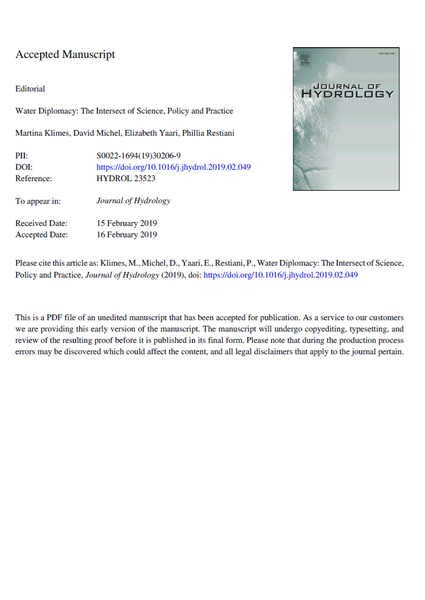
Authors: Martina Klimes, David Michel, Elizabeth Yaari, Phillia Restiani
Countries:
Source: Journal of Hydrology
Why water diplomacy? What does diplomacy have to do with water? Is cooperation over transboundary surface and ground waters the exclusive domain of diplomats and foreign policy experts? Or mainly the purview of water professionals negotiating agreements on shared water resources? Why should non-governmental stakeholders be involved in transboundary water dialogues? These questions lie at the heart of debates and dialogues around the theory and practice of water diplomacy.
Year: 2017
Collections: Scientific Publications
Topics: Water
Authors: Plekhanov P.A.
Countries: Kazakhstan
Year: 2023
Collections:
Topics: Water, IWRM
Authors: Domullodzhanov D., Rahmatilloev R.
Countries: Tajikistan
Source: Central Asian Journal of Water Research
Farmers in remote, arid areas, far from available water sources, need affordable water solutions for household and livestock use. In this study, the water needs and potential for rainwater harvesting (RWH) in the Kysylsu River Basin are estimated at different altitudes.
Year: 2016
Collections: Concept paper Scientific Publications, Research Paper, Review article,
Topics: Water, Sustainable Development, IWRM, Water law, Water diplomacy, Water governance
Authors: Patrick Huntjens, Yumiko Yasuda, Ashok Swain, Rens de Man, Bjørn-Oliver Magsig, Shafiqul Islam
Countries: N/A
Source: The Hague Institute for Global Justice
This publication is part of the project Water Diplomacy: Making Water Cooperation Work, led by The Hague Institute for Global Justice, in collaboration with Stockholm International Water Institute (SIWI), UNESCO Category II Centre for International Water Cooperation (ICWC), International Union for Conservation of Nature (IUCN), Uppsala University, University of Otago, University College Cork and Tufts University Water Diplomacy Program.
Year: 2022
Collections: Policy Briefs
Topics: Climate
Authors: Wesch Stefanie, Scheffran Jurgen Kogutenko Larissa, Rheinbay Janna,
Countries: Kazakhstan, Kyrgyzstan, Uzbekistan, Tajikistan, Turkmenistan, Afghanistan
Source:
Cooperative regional mechanisms and multi-stakeholder dialogue; adoption of local crossborder perspectives. Strengthening resilience of vulnerable communities. Monitoring and assessment of climate disaster risks in mountainous regions. Fast response mechanisms and disaster simulation drills.Investment in research on climate adaptation and disaster risk reduction; knowledge transfer and better established links between science and practitioners.
Year: 2024
Collections: Policy Briefs
Topics: Climate, Agriculture
Authors: Rieks Bosch
Countries: Kazakhstan, Kyrgyzstan, Uzbekistan, Tajikistan, Turkmenistan
Source:
The fertility of soil is depending on the minerals
available, the structure of soil, organic matter
in soil, water availability and micro organisms
living in the soil. Together they determine most of the productivity of land.
Year: 2025
Collections: Scientific Publications
Topics: Water, Climate
Authors: Rohullah Mayar, Mohammad Assem Mayar, Mohammad Hamid Omar
Countries: Afghanistan
Source: https://water-ca.org
Year: 2022
Collections: Scientific Publications
Topics: Energy
Authors: Rokita Dagmar, Sawatzki Rainer, Szyzdykova Raushan
Countries: Kazakhstan, Kyrgyzstan, Uzbekistan, Tajikistan, Turkmenistan
Source:
Year: 2020
Collections: Research Paper
Topics: Water
Authors: Krupa E., Barinova S., Romanova S., Aubakirova M., Ainabaeva N.
Countries: Kazakhstan
For questions about cooperation, please contact us at: