
Year: 2025
Collections: Books
Topics: Water, IWRM, Water governance, Water diplomacy, Transboundary Water Resources, Transboundary cooperation
Authors: Shafiqul Islam, Kevin Smith, Martina Klimes, Aaron Salzberg
Countries:
Source: Routledge Handbook of Water Diplomacy
Full book available here: https://drive.google.com/file/d/1V8lHqDiaqrMtHnU6JP9p9SBC2rsXY8gX/view?usp=sharing
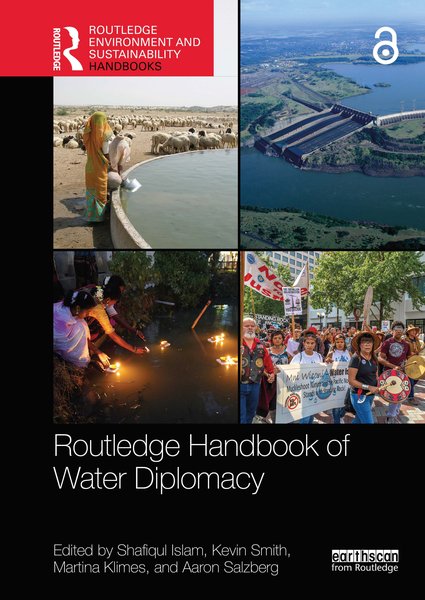
The Routledge Handbook of Water Diplomacy is a comprehensive guide to understanding and practicing water diplomacy – a framework for building relationships, negotiating shared interests, and managing complex water challenges across physical, political, and societal boundaries.
In an era marked by rising scarcity, deepening uncertainty, and growing geopolitical tension, this timely volume offers actionable insights for negotiated problem-solving grounded in both scientific understanding and diplomatic skill. Moving beyond abstract theory and technical fixes, the Handbook introduces a dual-pathway structure designed to meet the diverse needs of its users. The “Working Together” pathway invites readers to engage with water diplomacy through the lens of their roles, whether as professionals, decision-makers, funders, researchers, or affected communities. The “What Matters and Why” pathway highlights key thematic dimensions, including process design, adaptive learning, trust-building, divergent worldviews, and the management of uncertainty.
Year: 2018
Collections: Research Paper
Topics: Water governance, IWRM, Transboundary cooperation Irrigation,
Authors: Iroda Amirova, Martin Petrick, Nodir Djanibekov
Countries: Kazakhstan, Uzbekistan
Source: World Development
This study contributes to the understanding of long- and short-term determinants of cooperation among water users. We experimentally investigate the potential of water users’ self-governance in enhancing their contributions to a common pool as opposed to external regulation. Our focus is on the irrigated areas of Kazakhstan and Uzbekistan.
Year: 2021
Collections: Research Paper
Topics: Water
Authors: Masoomi B., Jaafarzadeh N., Tabatabaie Tayebeh, Jorfi S., Kouhgardi E.
Countries: Iran
Year: 2020
Collections: Scientific Publications
Topics: Water
Authors: Mayar M. A., Asady H., Nelson J.
Countries: Afghanistan
Year: 2018
Collections: Research Paper
Topics: Water diplomacy, Gender, IWRM, Water Security
Authors: Natasha Carmi, Mey Alsayegh, Maysoon Zoubi
Countries:
Source: Journal of Hydrology
Until now, limited attention has been afforded to the role of, and challenges faced by, women involved in water diplomacy. In addition to research being at an early stage, it is mainly focused on addressing the challenges imposed by gender inequality. Thus very few applicable policy recommendations have emerged in this field to date.
This paper will explore and identify current challenges that face the women interested in attaining high level positions in water diplomacy, in three Arab countries in which hydropolitics prevails, including Jordan, Lebanon and the State of Palestine. Female experts working on water-related issues were surveyed and interviewed to ascertain key qualitative issues, perceptions and various challenges.
Year: 2020
Collections:
Topics: Water, Climate, IWRM, Water diplomacy, Transboundary Water Resources, Water Security, Hydropower
Authors: Melinda Davies, Nathanial Matthews
Countries:
Source: International Journal of Water Resources Development
The article focuses on how China’s Belt and Road Initiative (BRI) may affect water resources and water governance in Central Asia. The authors consider Central Asia as a region that already faces a complex water situation, including transboundary rivers, water scarcity, the dependence of agriculture on irrigation, the environmental problems of the Aral Sea, weak coordination between countries, and the impacts of climate change. Against this background, the development of infrastructure, industry, hydropower, and agriculture under the BRI may increase pressure on water resources.
Year: 2024
Collections: Scientific Publications, Review article
Topics: Water, Climate, Water governance
Authors: Susanne Schmeier, Alexandra Turgul, Melissa McCracken, Zoe H. Rosenblum, Lynette de Silva, Aaron T. Wolf
Countries:
Source: Water International, 49(3-4), 274-288
This article explores major findings and evolutions in understandings of transboundary water conflict and cooperation over the last three decades, focusing on the trends emerging from the Transboundary Freshwater Diplomacy Database. It is found that since the 1940s, countries tend to cooperate over shared water resources, in contrast to media portrayals of 'water wars'. Water conflicts, which have increased slightly since 2000, are mostly fuelled by water quantity disputes or unilateral infrastructure developments. Institutions play a role in facilitating cooperation and reducing conflict over shared waters, but their growth and adoption have slowed over the last few decades.
Year: 2018
Collections: Research Paper
Topics: Water diplomacy, Gender, IWRM, Water Security
Authors: Natasha Carmi, Mey Alsayegh, Maysoon Zoubi
Countries:
Source: Journal of Hydrology
Until now, limited attention has been afforded to the role of, and challenges faced by, women involved in water diplomacy. In addition to research being at an early stage, it is mainly focused on addressing the challenges imposed by gender inequality. Thus very few applicable policy recommendations have emerged in this field to date.
This paper will explore and identify current challenges that face the women interested in attaining high level positions in water diplomacy, in three Arab countries in which hydropolitics prevails, including Jordan, Lebanon and the State of Palestine. Female experts working on water-related issues were surveyed and interviewed to ascertain key qualitative issues, perceptions and various challenges.
Year: 2013
Collections: Research Paper
Topics: Water, Water governance
Authors: Michael Eichholz, Kristof Van Assche, Lisa Oberkircher, Anna-Katharina Hornidge
Countries: Uzbekistan
Source: Journal of Environmental Planning and Management
This article analyzes the governance of land and water resources in rural Uzbekistan through the lens of Pierre Bourdieu’s sociological theory. The authors explore how farmers adapt to post-socialist reforms and successive waves of land consolidation by relying on different forms of capital, including social, political, and symbolic capital. The study demonstrates that, in the absence of an open market and transparent rules, access to resources becomes the outcome of continuous negotiations and exchanges of favors. Under conditions of high uncertainty, social networks and proximity to political authorities prove to be more important than direct financial investments. As a result, the rural economy is transformed into a complex system of personal arrangements, where the survival and success of farming households depend on farmers’ ability to convert their informal assets into actual access to land and water resources.
For questions about cooperation, please contact us at: