

Year: 2024
Collections: Policy Briefs
Topics: Climate
Authors: Zhakenova Saltanat, Arsen Tleppayev, Nodir Djanibekov, Viktoriya Krylova
Countries: Kazakhstan, Kyrgyzstan, Uzbekistan, Tajikistan, Turkmenistan
Source:
Universities and academia in Central Asia play a crucial role in addressing climate change impacts, including rising temperatures, diminishing water resources, and increased frequency of extreme weather events threatening agriculture and livelihoods. Academic efforts must prioritize research on tailored adaptation strategies to foster resilience and sustainability. However, there's an underrepresentation of climate change research from Central Asia, emphasizing the urgent need for expanded research efforts.
Year: 2025
Collections: Scientific Publications
Topics: Water, IWRM
Authors: Gafurov A., Ziganshina Dinara, Assubayeva A., Nodir Djanibekov, Abdullaev Iskandar, Bobojonov Ihtiyor, Dombrowsky Ines, Hamidov Ahmad, Herrfahrdt-Pähle Elke, Janusz-Pawletta Barbara, Ishangulyyev Rovshen, Kasymov Ulan, Mirkasimov Bakhrom, Petrick Martin, Strobehn Katrin
Countries: Kazakhstan, Kyrgyzstan, Uzbekistan, Tajikistan, Turkmenistan
Source: water-ca.org
Political tensions over water management in the Central Asia region have intensified since the Soviet era, as ecological issues like the drying Aral Sea and seasonal hydropower disruptions impact downstream countries. The paper discusses the region’s water governance challenges, including climate-induced uncertainties, water resource demands, and the limited capacity of local research institutions. While Central Asia’s governments have initiated reforms, including new infrastructure and agreements, resilience in water management remains underdeveloped. The paper also explores the role of higher education institutions in fostering capacity-building for sustainable governance, emphasizing the need for local expertise and regional collaboration. The proposed establishment of a Central Asian water research platform aims to enhance science-policy integration, promote sustainable water governance, and support informed regional cooperation on transboundary water issues.
Year: 2015
Collections: Research Paper
Topics: Water governance, Transboundary Water Resources, Hydropolitics
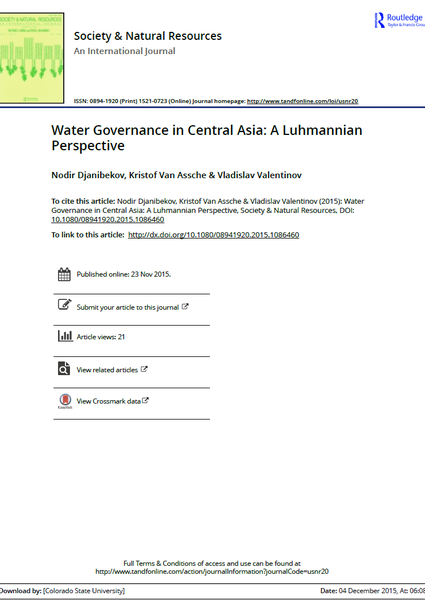
Authors: Nodir Djanibekov, Kristof Van Assche, Vladislav Valentinov
Countries:
Source: Society & Natural Resources
The article focuses on the problems of transboundary water governance in Central Asia from the perspective of Niklas Luhmann’s social systems theory. The authors examine why, after the collapse of the Soviet Union, it became difficult to coordinate the use of the water-energy infrastructure of the Amu Darya and Syr Darya rivers. During the Soviet period, water, energy, and agriculture were managed through a centralized system. However, after 1991, each country began to develop its own national policy. This strengthened contradictions between upstream countries, which need water for hydropower production, and downstream countries, which need water for irrigation.
Year: 2018
Collections: Research Paper
Topics: Water governance, IWRM, Transboundary cooperation Irrigation,
Authors: Iroda Amirova, Martin Petrick, Nodir Djanibekov
Countries: Kazakhstan, Uzbekistan
Source: World Development
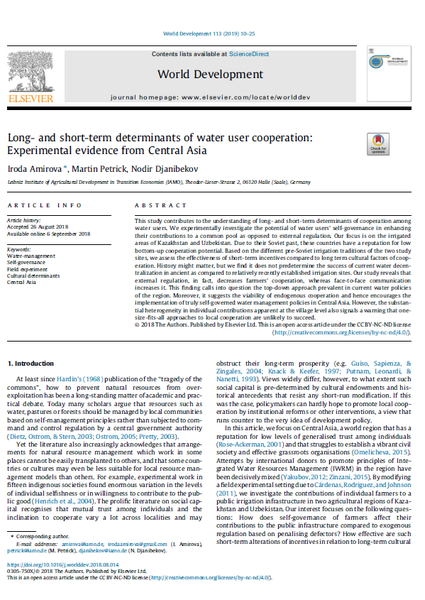
This study contributes to the understanding of long- and short-term determinants of cooperation among water users. We experimentally investigate the potential of water users’ self-governance in enhancing their contributions to a common pool as opposed to external regulation. Our focus is on the irrigated areas of Kazakhstan and Uzbekistan.
Year: 2017
Collections: Scientific Publications
Topics: Water
Authors: Wegerich Kai, Zaryab A., Klove B., Noori Ali Reza
Countries: Afghanistan
Year: 2020
Collections: Scientific Publications
Topics: IWRM
Authors: Nori S. M.
Countries: Afghanistan
Year: 2020
Collections: Research Paper
Topics: Water
Authors: Mitusov A., Normakhmedova Z. O., Kurbonov N. B.
Countries: Tajikistan
Year: 2024
Collections: Policy Briefs
Topics: Energy
Authors: Kobzev A., Manuel Andresh, Abylaikhan Soltanayev, Nurbek Yessetov
Countries: Kazakhstan
Source:
Year: 2022
Collections: Policy Briefs
Topics: Energy
Authors: Nurbossynova Saltanat, Idrissov Marat
Countries: Kazakhstan, Kyrgyzstan, Uzbekistan, Tajikistan, Turkmenistan
Source:
Year: 2024
Collections: Scientific Publications
Topics: Water, Sustainable Development
Authors: Catalin Stefan, Jana Sallwey, Nurlan Ongdas, Mohammad Al-Hosban
Countries: Kazakhstan
Source: https://water-ca.org
MAR remains relatively underutilized in Central Asia despite its potential to address water scarcity issues, particularly those related to seasonal fluctuations in water availability. Thus, the objective of this study was to produce a map depicting the potential suitability of managed aquifer recharge (MAR) implementation in Kazakhstan. Employing a multi-criteria decision analysis framework, five distinct physical criteria were integrated and visualized within a Geographic Information System (GIS) to delineate the intrinsic potential for MAR. To demonstrate the practical utility of the generated map, it was applied to the Zhambyl region in Southern Kazakhstan, an area previously afflicted by water scarcity challenges. The intrinsic MAR potential map was overlaid with remote sensing data identifying potential water sources and water utilization patterns. This overlay facilitated the identification of priority areas with potential for further evaluation for MAR implementation. The map developed for Kazakhstan represents the first spatial representation of MAR potential within the region, serving to raise awareness regarding the feasibility of MAR application. It is anticipated that dissemination of this map will enhance understanding among water management professionals, potentially catalysing the integration of MAR methodologies into regional water management strategies.
Year: 2024
Collections: Scientific Publications
Topics: Water
Authors: Barakov R.Т., Sharakhmatov S.Е., Isbekov К.B., Nurtazin S.Т.
Countries: Kazakhstan
Source: https://water-ca.org/
The article presents the results of investigating the morphological variability of carp (Cyprinus carpio Linnaeus, 1758) in three large reservoirs of the Balkash-Alakol Basin – Lake Balkash, Lake Alakol, and Kapshagay Reservoir. Morphological differences in several features (counting and plasticity) were found in three carp samples. The study included the examination of 24 plastic and 14 counting features. The method of digital image processing (Morpho J) was applied to analyze the differences of the target fish species specimens by body shape. The application of the principal component analysis (PCA) method allowed determining the main loadings on the studied morphological traits of carp. The statistically reliable differences revealed allow to confirm the formation of morphological changes in carp caused by
the duration of adaptive radiation, environmental factors of water bodies and annual artificial stocking of young fish.
For questions about cooperation, please contact us at: