
Year: 2024
Collections: Scientific Publications
Topics: Water
Authors: Maiwand Omary, Mohammad Najim Nasimi, Mohammad Nasim Nasimi
Countries: Afghanistan
Source: https://water-ca.org
This study aimed to evaluate the suitability of Kabul Province’s groundwater for drinking by way of analyzing the data collected from 34 ground monitoring wells. The purpose was helped through the assessment of a set of groundwater physico-chemical parameters (pH, turbidity, total dissolved solids (TDS); sulfate, fluoride, nitrate, and boron content; total hardness (TH) as calcium carbonate, sodium, calcium, magnesium, and total iron), as well as the determination of the Water Quality Index (WQI) developed based on sampling the water points located in the districts of Kabul Province and Kabul City in the course of 3 years (2018 to 2020) to provide a clear and concise representation of water quality status, and cat-egorize groundwater into different quality classes ranging from “excellent” to “unsuitable for drinking”. Moreover, the spatial distribution of WQI and 12 physico-chemical parameter values was mapped using the Inverse Distance Weighted (IDW) Interpolation in Arcmap 10.7 environment, revealing distinct water quality patterns across the study area. The water qual-ity testing outcomes under this investigation show compliance of multiple water contaminant concentrations with the World Health Organization (WHO) Water Quality Guidelines and Afghanistan National Drinking Water Quality Standards (ANDWQS). The WQI values range between 27.5 and 112 (as per ANDWQS) and between 33 and 127.5 (as per WHO Guide-lines); the WQI (WHO) display 9% and WQI (ANDWQS) display 3% of groundwater unsuit-able for drinking. Spatial variation maps (IDW Interpolation) demonstate that turbidity, TDS, TH, and magnesium concentration values for the provinces’s central and eastern sec-tions exceed the permissible thresholds. The study’s findings underscore the need for target-ed groundwater management strategies, including pollution control and regular monitoring, to safeguard water quality and public health in Kabul Province.
Year: 2017
Collections: Scientific Publications
Topics: Water, Climate
Authors: Kalashnikova O. Ju., Abdibachaev U. A., Moldobekov B. D.
Countries: Kyrgyzstan
Year: 2017
Collections: Scientific Publications
Topics: Water, Climate
Authors: Mukhamedova Nozilakhon, Wegerich Kai
Countries: Uzbekistan
Year: 2021
Collections: Research Paper
Topics: Water
Authors: Mukhtarova A.
Countries: Kazakhstan, Kyrgyzstan, Uzbekistan, Tajikistan, Turkmenistan
Year: 2023
Collections: Research Paper
Topics: Water
Authors: Mukhtarova A.
Countries: Kazakhstan, Kyrgyzstan, Uzbekistan, Tajikistan, Turkmenistan
Source: Central Asian Journal of Water Research
Academic scholarship defines sectoral corruption, namely water corruption one of the main threats to the development of Central Asia. While applying a rapid review, the purpose of this article is to explore the current state of research on water corruption, its various forms, and typologies in different water sectors (such as water supply and sanitation, irrigation, hydropower, and water resources management).
Year: 2022
Collections: Policy Briefs
Topics: Agriculture, Sustainable Development
Authors: Guggenberger Georg, Shibistova Olga, Liebelt Peter, Muminjanov Hafiz, Kassam Amir, Friedrich Theodor
Countries: Kazakhstan, Kyrgyzstan, Uzbekistan, Tajikistan, Turkmenistan, Afghanistan
Source:
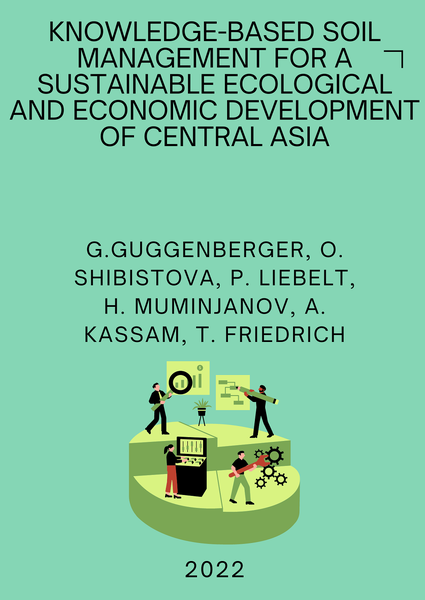
Soil degradation is widespread and cross-border in Central Asia with multiple symptoms. This impairs the provision of ecosystem services, including food production, climate change mitigation, biodiversity, and human health. The soil health concept links soil management to broader sustainable development goals. Soil knowledge and its application has to be invigorated, for instance by establishing a Central Asian Soil Competence Network.
Year: 2024
Collections: Scientific Publications
Topics: Climate
Authors: Isaev E., Murata Akihiko, Shin Fukui, Roy C. Sidle
Countries: Kazakhstan, Kyrgyzstan, Uzbekistan, Tajikistan, Turkmenistan, Afghanistan
Source: https://water-ca.org/
Climate change poses various challenges for agriculture and water management practices in Central Asia (CA). Central to these challenges are cryosphere dynamics, fragile mountain ecosystems, and ongoing natural hazards that highlight the need for robust projections of regional climate change. For the first time, dynamic downscaling was conducted in Central Asia at a spatial resolution of 5 km.
Year: 2023
Collections: Research Paper
Topics: Water
Authors: Makhmudova L., Mussina A., Ospanova M., Zharylkassyn A., Kanatuly A.
Countries: Kazakhstan
Source: Central Asian Journal of Water Research
The research aimed to assess the impact of human economic activities on the Yesil River Basin based on the observational data contained in Kazhydromet’s (Republic State Enterprise, RSE) hydrometeorological periodicals of 1933-2019. The additional analysis of numerous sources – statistics digests, online data of the Bureau of National Statistics under the Agency for Strategic Planning and Reforms of the Republic of Kazakhstan (RK), monographs and scientific papers also allowed to reliably evaluate the overall water consumption in the country.
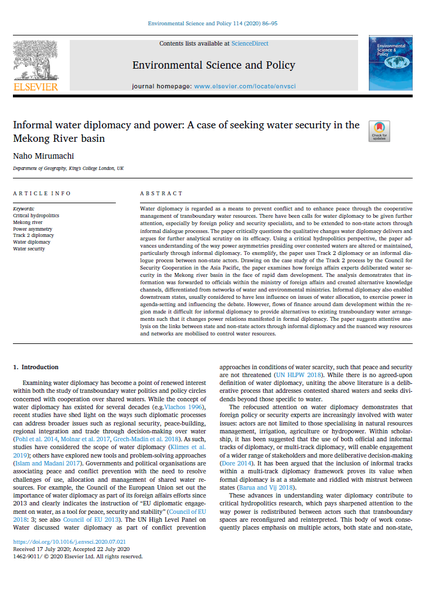
Year: 2020
Collections:
Topics: Water diplomacy, Water, IWRM, Transboundary Water Resources, Hydropolitics
Authors: Naho Mirumachi
Countries:
Source: Environmental Science and Policy
Water diplomacy is regarded as a means to prevent conflict and to enhance peace through the cooperative management of transboundary water resources. There have been calls for water diplomacy to be given further attention, especially by foreign policy and security specialists, and to be extended to non-state actors through informal dialogue processes. The paper critically questions the qualitative changes water diplomacy delivers and argues for further analytical scrutiny on its efficacy. Using a critical hydropolitics perspective, the paper advances understanding of the way power asymmetries presiding over contested waters are altered or maintained, particularly through informal diplomacy.
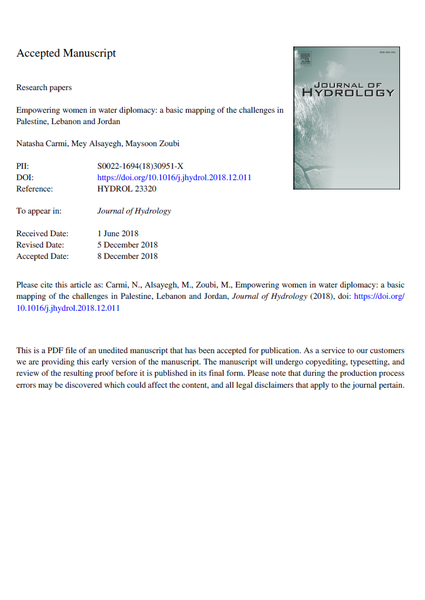
Year: 2018
Collections: Research Paper
Topics: Water diplomacy, Gender, IWRM, Water Security
Authors: Natasha Carmi, Mey Alsayegh, Maysoon Zoubi
Countries:
Source: Journal of Hydrology
Until now, limited attention has been afforded to the role of, and challenges faced by, women involved in water diplomacy. In addition to research being at an early stage, it is mainly focused on addressing the challenges imposed by gender inequality. Thus very few applicable policy recommendations have emerged in this field to date.
This paper will explore and identify current challenges that face the women interested in attaining high level positions in water diplomacy, in three Arab countries in which hydropolitics prevails, including Jordan, Lebanon and the State of Palestine. Female experts working on water-related issues were surveyed and interviewed to ascertain key qualitative issues, perceptions and various challenges.
Year: 2020
Collections:
Topics: Water, Climate, IWRM, Water diplomacy, Transboundary Water Resources, Water Security, Hydropower
Authors: Melinda Davies, Nathanial Matthews
Countries:
Source: International Journal of Water Resources Development
The article focuses on how China’s Belt and Road Initiative (BRI) may affect water resources and water governance in Central Asia. The authors consider Central Asia as a region that already faces a complex water situation, including transboundary rivers, water scarcity, the dependence of agriculture on irrigation, the environmental problems of the Aral Sea, weak coordination between countries, and the impacts of climate change. Against this background, the development of infrastructure, industry, hydropower, and agriculture under the BRI may increase pressure on water resources.
For questions about cooperation, please contact us at: