
Year: 2025
Collections: Scientific Publications
Topics: Agriculture
Authors: Ankit Garg, Sai Krishna Akash Ramineni, Neelima Satyam, Askar Zhussupbekov
Countries: Kazakhstan, Kyrgyzstan, Uzbekistan, Tajikistan, Turkmenistan
Source: https://cajscr.com/
Soil salinity in Central Asia negatively impacts soil structure, leading to degradation and reduced water infiltration. This not only hampers agricultural productivity but also makes the land less suitable for construction due to its high susceptibility to deformation. Environmentally friendly materials like biochar, a carbon-rich substance, show promise in reducing the deformation of saline soils. However, the mechanisms behind its effectiveness are not yet fully understood. This study aims to analyse saline clays’ dispersion and sedimentation behaviour under varying pore water salinity levels (0 % to 10%). A biochar content of 5 % was selected as it is found to be optimum for plant growth and erosion resistance. It was found from the study that the biochar increases the aggregation of soil particles and enhances flocculation, improving soil dispersion characteristics. Biochar facilitates soil particle aggregation by increasing the cation exchange capacity. At higher pore water salinity levels (5% and 10%), the sedimentation behaviour of biochar-treated soil particles deviates from expectations, showing slower sedimentation rates and lower sedimentation heights. This is because the sodium ions are adsorbed by biochar, reducing salt’s effect on dispersion and sedimentation. The results demonstrate that biochar effectively enhances the stability of saline soils and, hence, has a potential use for ground improvement in the Central Asian region.
Year: 2024
Collections: Scientific Publications
Topics: Water
Authors: Tillakarim T., Serikbay N., Satmurzayev A., Sairov S.
Countries: Kazakhstan
Source: water-ca.org
The research aimed to evaluate the possibility of applying the HBV model for assessing the flow of the Ile Alatau Mountain Range rivers. The main part of the corresponding water resources forms on the northern slopes of the Ile Alatau making them a significant water balance and water supply factor for the major cities of Almaty, Kaskelen, Talgar, and Yesik.
Year: 2021
Collections: Scientific Publications
Topics: Agriculture
Authors: Salmukhanbetova Zh.K., Imanalinova A. A., Dimeyeva L. A., Zverev N.E.
Countries: Kazakhstan
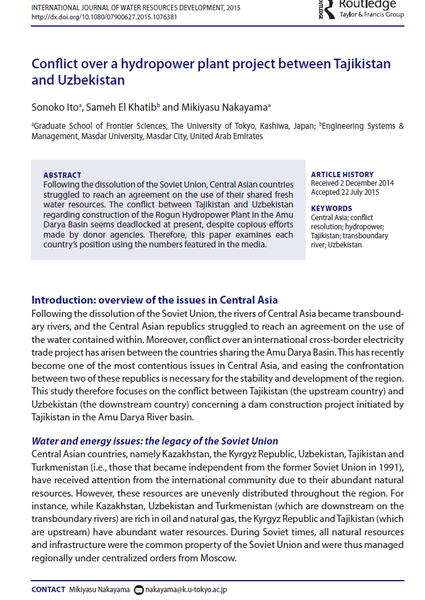
Year: 2014
Collections: Research Paper
Topics: Water, Transboundary Water Resources, Hydropower
Authors: Sonoko Ito, Sameh El Khatib, Mikiyasu Nakayama
Countries: Uzbekistan, Tajikistan
Source: International Journal of Water Resources Development
Following the dissolution of the Soviet Union, Central Asian countries struggled to reach an agreement on the use of their shared fresh water resources. The conflict between Tajikistan and Uzbekistan regarding construction of the Rogun Hydropower Plant in the Amu Darya Basin seems deadlocked at present, despite copious efforts made by donor agencies. Therefore, this paper examines each country’s position using the numbers featured in the media.
Year: 2022
Collections: Policy Briefs
Topics: Sustainable Development
Authors: Samekina S., Issayeva G.
Countries: Kazakhstan
Source:
An individual monotown is a unique combination of available resources, trends and potential. Earlier management decisions, due to their uniformity, did not take such specifics into account. As a result, state support measures have not had the expected effect. The introduction of a differentiated approach to regional policy transformation can therefore be a trigger for positive change.
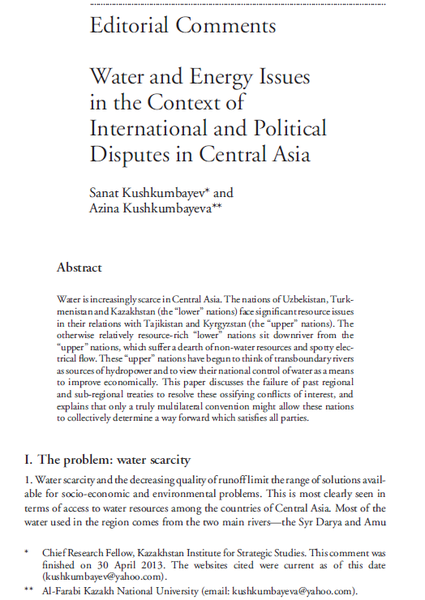
Year: 2013
Collections: Research Paper
Topics: Water, Transboundary Water Resources, Transboundary cooperation, Hydropower
Authors: Sanat Kushkumbayev, Azina Kushkumbayeva
Countries: Kazakhstan, Kyrgyzstan, Uzbekistan, Tajikistan, Turkmenistan
Source: Chinese Journal of International Law
This paper discusses the failure of past regional and sub-regional treaties to resolve these ossifying conflicts of interest, and explains that only a truly multilateral convention might allow these nations to collectively determine a way forward which satisfies all parties.
Year: 2017
Collections: Research Paper
Topics: Water, Water governance, Transboundary Water Resources, Transboundary cooperation, Hydropolitics
Authors: Sarah Acquah, Frank A. Ward
Countries:
Source: Water Resources Management
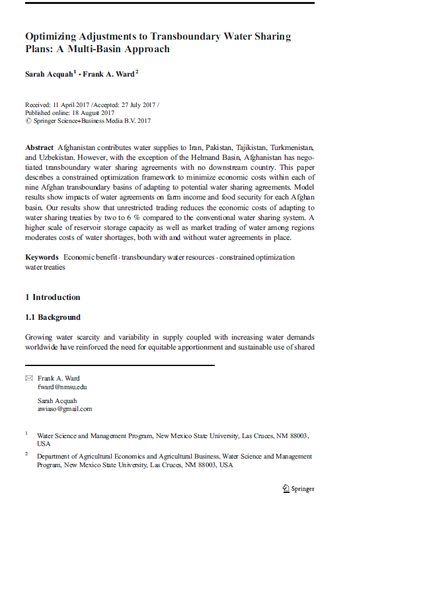
Afghanistan contributes water supplies to Iran, Pakistan, Tajikistan, Turkmenistan, and Uzbekistan. However, with the exception of the Helmand Basin, Afghanistan has negotiated transboundary water sharing agreements with no downstream country. This paper describes a constrained optimization framework to minimize economic costs within each of nine Afghan transboundary basins of adapting to potential water sharing agreements.
Year: 2017
Collections: Research Paper
Topics: Water, Climate, IWRM, Transboundary Water Resources, Transboundary cooperation
Authors: Sarah Hummel
Countries:
Source: International Studies Quarterly
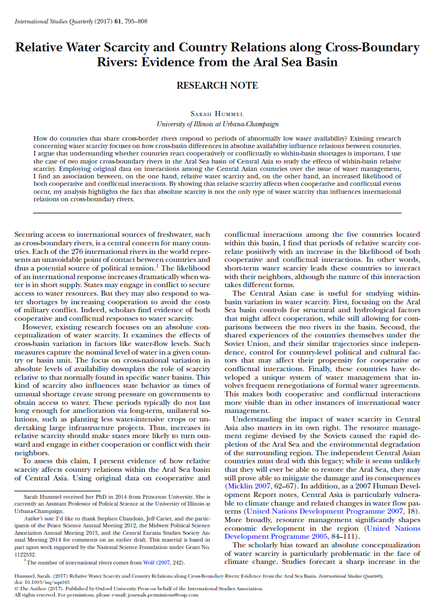
This scientific article examines the impact of relative water scarcity on international relations in the Aral Sea Basin. The author distinguishes between absolute water scarcity, determined by the overall availability of water resources, and relative water scarcity, defined as temporary deviations from normal water availability within a specific river basin. Based on an analysis of hydrological and political data from the Amu Darya and Syr Darya river basins in Central Asia, the study concludes that short-term water shortages stimulate states to take more active policy actions. The findings demonstrate that periods of water scarcity increase the likelihood of both cooperative and conflictual interactions among neighboring countries. This suggests that states employ a variety of foreign policy instruments to address transboundary water challenges under conditions of resource variability. The results highlight the importance of considering climate variability when assessing and forecasting transboundary water disputes and cooperation.
Year: 2019
Collections: Research Paper
Topics: Water, Transboundary Water Resources, Transboundary cooperation, Hydropower
Authors: Sara McLaughlin Mitchell, Sojeong Lee
Countries:
Source: Journal of Peace Research
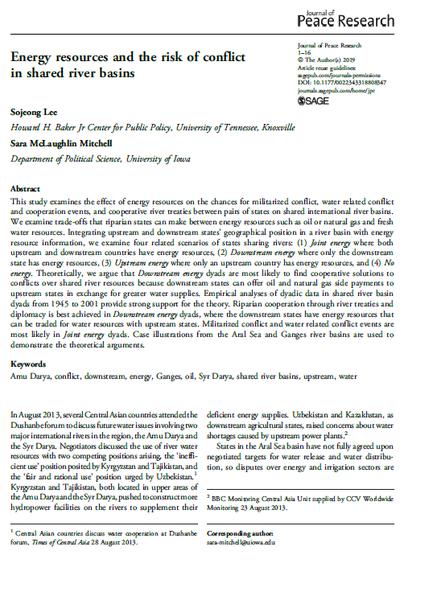
This study examines the effect of energy resources on the chances for militarized conflict, water related conflict and cooperation events, and cooperative river treaties between pairs of states on shared international river basins.
For questions about cooperation, please contact us at: