

Year: 2020
Collections: Scientific Publications
Topics: Water
Authors: Thevs Niels, Tesch N.
Countries: Kazakhstan, Kyrgyzstan, Uzbekistan, Tajikistan, Turkmenistan
Year: 2022
Collections: Research Paper
Topics: Water, Sustainable Development, NEXUS, Water governance, Transboundary Water Resources
Authors: Ahmad Hamidov, Katrin Daedlow, Heidi Webber, Hussam Hussein, Ilhom Abdurahmanov, Aleksandr Dolidudko, Ali Yawar Seerat, Umida Solieva, Tesfaye Woldeyohanes, Katharina Helming
Countries:
Source: Ecology and Society
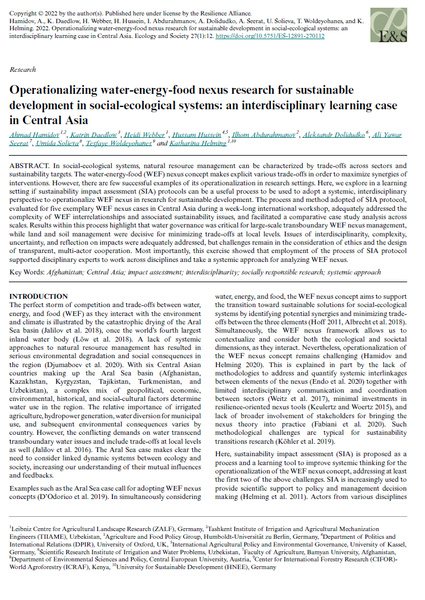
This article focuses on the operationalization of the Water–Energy–Food (WEF) Nexus concept as a framework for promoting sustainable development in Central Asia. The researchers examine the application of the Sustainability Impact Assessment (SIA) protocol as a tool for interdisciplinary analysis of five different environmental systems across the region. The findings demonstrate that a systems-based approach helps experts identify critical trade-offs between water resource management, energy production, and soil conservation. The authors emphasize that the SIA framework is effective in addressing interdisciplinary complexity; however, it requires further development in areas related to ethics and stakeholder engagement. Overall, the study highlights that regional cooperation and the integration of scientific approaches are essential for mitigating the impacts of environmental degradation, including challenges such as the desiccation of the Aral Sea. The article therefore provides a methodological foundation for translating theoretical nexus concepts into practical strategies for natural resource management and sustainable development.
Year: 2017
Collections: Research Paper
Topics: Sustainable Development, Water governance, Transboundary Water Resources, Transboundary cooperation
Authors: Thang Vo, Thong Tran, Duy Luong
Countries:
Source: Journal of Economic Development
This scientific paper examines water resource management as a key factor in achieving sustainable development, with a particular focus on the Mekong Delta region of Vietnam. The authors analyze global challenges, including freshwater scarcity driven by population growth and climate change, which contribute to droughts and soil salinization. The paper reviews international water governance models implemented in OECD and Latin American countries and identifies common challenges, such as financial constraints and information gaps. The study highlights the critical dependence of Vietnam’s agricultural sector on effective water governance and the efficient allocation of water resources. International experience is presented as a valuable foundation for reforming institutional frameworks and preventing social conflicts arising from water scarcity. The authors conclude by emphasizing the need for a flexible and adaptive water governance system capable of responding to contemporary environmental challenges.
Year: 2022
Collections: Scientific Publications
Topics: Water
Authors: Thevs Niels, Aliev Kumar
Countries: Kazakhstan
Source:
Year: 2018
Collections: Scientific Publications
Topics: Water
Authors: Thevs Niels, Aliev Kumar, Rouzi Ahemaitijiang, Abudushalike Nuerbayi
Countries: China
Year: 2018
Collections: Scientific Publications
Topics: Water
Authors: Thevs Niels, Aliev Kumar, Strenge Eva, Eraaliev Maksat, Lang Petra, Baibagysov Azim
Countries: Kazakhstan
Year: 2020
Collections: Scientific Publications
Topics: Water
Authors: Thevs Niels, Tesch N.
Countries: Kazakhstan, Kyrgyzstan, Uzbekistan, Tajikistan, Turkmenistan
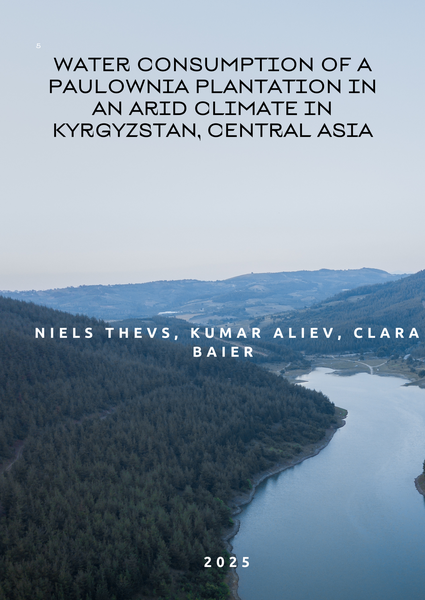
Year: 2025
Collections: Scientific Publications
Topics: Water, Climate
Authors: Thevs Niels, Aliev Kumar, Baier Clara
Countries: Kyrgyzstan
Source: water-ca.org
Recently, Paulownia spec. has been introduced to Central Asia in a number of small plantations. Paulownia yields timber of high quality for applications such as furniture, house construction, boat construction, and surf boards, or skis. Thus, Paulownia might offer a much-needed raw material for this region and beyond. However, Central Asia is largely occupied by drylands so that Paulownia needs irrigation. Against the background of frequent water stress across the region, this study aimed at assessing the water consumption and water productivity of that tree, using a 6-year-old plantation as study site. Trees were planted in May 2017 and cut back to their stumps in 2018. Daily crop evapotranspiration was calculated after the Penman-Monteith approach, whereby the crop coefficients were inherited from actual evapotranspiration values which stemmed from the remote sensing approach S-SEBI. Water consumption per tree was 1741 l, 4461 l, 4500 l, and 4407 l over the growing seasons 2020, 2021, 2022, and 2023, respectively. The water productivity for the stem wood over the whole time-span from planting in 2017 until 2023 was 1.59 g l-1 and 5.65 ml l-1. Given the high quality of its timber and its range of high-value applications, it can be concluded that the water consumed by Paulownia enables higher value timber and timber products than other trees that grow in comparable areas of Central Asia.
Year: 2012
Collections:
Topics: Water, Climate, NEXUS, Hydropolitics
Authors: Thomas Bernauer, Tobias Siegfried
Countries: Kazakhstan, Kyrgyzstan, Uzbekistan, Tajikistan
Source: Journal of Peace Research
The authors engage in a critical assessment of the neo-malthusian claim that climatic changes can be an important source of international tensions, in the extreme even militarized interstate disputes.
Year: 2008
Collections: Books
Topics: Water, Sustainable Development, IWRM, Water diplomacy, Transboundary Water Resources, Water Security, Transboundary cooperation, Hydropolitics
Authors: Thomas Bernauer, Tobias Siegfried
Countries:
Source:
This book chapter examines the compliance and actual performance of an international water agreement in the Naryn/Syr Darya Basin in Central Asia. The authors analyze the 1998 agreement, which was designed to regulate the operation of the Toktogul Reservoir by balancing Kyrgyzstan’s need for winter hydropower production with Uzbekistan’s and Kazakhstan’s need for summer irrigation water. The main argument of the article is that formal compliance with an agreement does not necessarily mean that the agreement is effective in solving the real water allocation problem. Using the policy performance metric (PER), the authors show that although compliance with the agreement was relatively high, its actual performance was low and highly variable. The article concludes that the existing water management system in the Naryn/Syr Darya Basin requires urgent institutional reform.
Year: 2017
Collections: Research Paper
Topics: Water, Water Security
Authors: Frederike Klümper, Thomas Herzfeld, Insa Theesfeld
Countries: Tajikistan
Source: Water
This scientific article examines the concept of water security in the irrigation sector of Tajikistan at the individual farm level. The authors develop a comprehensive Water Security Index that incorporates hydrological, governance, and hybrid dimensions to assess the actual availability and accessibility of water resources. The study reveals that, despite the physical abundance of water, weak governance and institutional barriers are the primary sources of water insecurity. Based on a survey of 399 farming households, the authors establish a typology of farms, demonstrating that large and small producers face fundamentally different water-related challenges. The findings show that effective governance can compensate for infrastructure deficiencies, thereby enhancing the resilience of agricultural production. The article concludes by emphasizing the need to shift from broad national water security indicators toward targeted support for local water distribution and management systems.
Year: 2017
Collections: Research Paper
Topics: Sustainable Development, Water governance, Transboundary Water Resources, Transboundary cooperation
Authors: Thang Vo, Thong Tran, Duy Luong
Countries:
Source: Journal of Economic Development
This scientific paper examines water resource management as a key factor in achieving sustainable development, with a particular focus on the Mekong Delta region of Vietnam. The authors analyze global challenges, including freshwater scarcity driven by population growth and climate change, which contribute to droughts and soil salinization. The paper reviews international water governance models implemented in OECD and Latin American countries and identifies common challenges, such as financial constraints and information gaps. The study highlights the critical dependence of Vietnam’s agricultural sector on effective water governance and the efficient allocation of water resources. International experience is presented as a valuable foundation for reforming institutional frameworks and preventing social conflicts arising from water scarcity. The authors conclude by emphasizing the need for a flexible and adaptive water governance system capable of responding to contemporary environmental challenges.
Year: 2024
Collections: Scientific Publications
Topics: Water
Authors: Tillakarim T., Serikbay N., Satmurzayev A., Sairov S.
Countries: Kazakhstan
Source: water-ca.org
The research aimed to evaluate the possibility of applying the HBV model for assessing the flow of the Ile Alatau Mountain Range rivers. The main part of the corresponding water resources forms on the northern slopes of the Ile Alatau making them a significant water balance and water supply factor for the major cities of Almaty, Kaskelen, Talgar, and Yesik.
Year: 2023
Collections: Scientific Publications
Topics: Climate
Authors: Tleppayev A., Zeinolla S.
Countries:
Source: Central Asian Journal of Sustainability and Climate Research
This study aims to identify the relationship between CO2 emissions and economic growth to assess the influence on climate change. Design: The algorithm was chosen for research provision: statistical and comparative analysis, correlation, and regression analysis. The data for 1999-2020 was obtained from the World Bank and the Bureau of National Statistics. Results: After looking at the conditions and factors that affect Kazakhstan’s energy system, we believe it is essential to study how different factors affect economic growth, with a focus on environmental change. The results of modeling with regression models back this up. The model demonstrated that energy consumption has the most significant influence on CO2 emissions; however, in the GDP model, all factors, such as urbanization, energy consumption, and energy pricing, had an equal impact.

Year: 2024
Collections: Scientific Publications
Topics: Water, Climate
Authors: Aidar Zhumabaev, Hannah Schwedhelm, Beatrice Marti, Silvan Ragettli, Tobias Siegfried
Countries: Kazakhstan
Source: https://water-ca.org
The Badam River, a tributary to the Arys River located in the Syr Darya basin, is a crucial natural resource for ecological, social, and economic activities in the semi-arid region of southern Kazakhstan. The river basin is heavily influenced by manmade water infrastructure and faces water scarcity, particularly during summer, highlighting the importance of understanding its hydrological processes for effective water resource management. In this study, a semi-distributed conceptual hydrological model of the Badam River was implemented using the RS MINERVE hydrological software to evaluate the impacts of climate change on hydrology and to test the resilience of the water system. Connected HBV models were implemented for each of the hydrological response units that were defined as altitudinal zones. The hydrological model was calibrated using daily time steps between 1979 and 2011, and the resulting flow exceedance curves and hydrographs were used to assess the potential impacts of climate change on the basin, using CMIP6 precipitation and temperature scenarios. Future climate scenarios for the 2054 – 2064 period demonstrate that the peak discharge will be shifted to spring/late spring compared to the current early summer with no significant decrease in average discharge per day of the year. The insights gained from this hydrological-hydraulic model can be used to effectively manage the water system and inform future hydropower design decisions and serve as a blueprint for similar studies in the region and elsewhere.
For questions about cooperation, please contact us at: