
Year: 2024
Collections: Scientific Publications
Topics: Climate
Authors: Susan Legro
Countries: Kazakhstan, Kyrgyzstan, Uzbekistan, Tajikistan, Turkmenistan
Source: Central Asian Journal of Sustainability and Climate Research
Countries in Central Asia, which are highly vulnerable to climate change, experience a variety of health-related impacts to which they must adapt. At the same time, climate mitigation interventions in the health sector in the form of reduced greenhouse gas (GHG) emissions may also generate co-benefits. This article briefly outlines current understanding of the relationship between climate change impacts and human health in Central Asia and establishes a scope of inquiry based on climate and health linkages as identified by the Intergovernmental Panel on Climate Change (IPCC). It then identifies and summarizes existing research and reporting on this topic in the region as presented in published literature, country reporting to the United Nations Framework Convention on Climate Change (UNFCCC), and gray literature, including policy literature and documentation of donor-funded development interventions in the region. This review, which attempts to summarize and appraise those efforts, has found that both peer-reviewed and grey literature on this topic must be used with caution. The most frequent problems with peer-reviewed and grey literature resources involved confounding bias, and—to a lesser extent—self-reporting bias. The use of an appraisal framework for grey literature sources can frame these diverse resources in the proper context, identify potential shortcomings, and gain insights into current priorities and future direction for research on climate change and health in the region.

Year: 2021
Collections: Scientific Publications, Review article
Topics: Water, Water law, Water diplomacy
Authors: Susanne Schmeier
Countries:
Source: American Journal of International Law, 115, 173-177
International water law (IWL) principles are often called upon to address disagreements and conflict between riparian states to a shared watercourse, with various parties invoking them to guide states’ behavior towards cooperative solutions that benefit the water resources as well as broader regional cooperation and peace. This essay argues that it is particularly important to acknowledge the role IWL principles play in negotiation processes, that is, in an ex ante and non-judicial function, providing a framework for cooperation and contributing to lawmaking, which makes them important tools of international relations and water diplomacy.
Year: 2018
Collections: Scientific Publications, Review article
Topics: Water, Water diplomacy
Authors: Susanne Schmeier, Zaki Shubber
Countries:
Source: Journal of Hydrology
Water diplomacy needs institutional anchoring. International River Basin Organizations (RBOs) – being the result of diplomatic efforts by riparian states intending to create a framework for cooperation between themselves over shared water bodies – can provide such institutional anchors. RBOs ensure that agreements to cooperate are turned into a long-term commitment by riparian states to jointly manage shared water resources and, in turn, foster mutually beneficial cooperation over time. RBOs have been the subject of detailed examinations of their conceptual core, of their manifold functions, of their effectiveness in achieving their goals and so forth. However, the legal nature of these entities has so far received limited attention notwithstanding its significance in empowering RBOs to act as institutional anchors for water diplomacy.
Year: 2022
Collections: Scientific Publications, Review article
Topics: Water, Water governance Water diplomacy,
Authors: Bota Sharipova, Susanne Schmeier, Rozemarijn ter Horst, Alyssa Offutt, Jenniver Sehring
Countries:
Source: Diplomatica, 4(2), 200-221
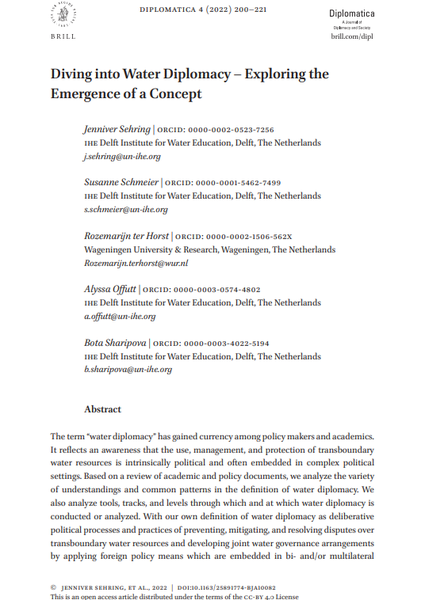
Based on a review of academic and policy documents, we analyze the variety of understandings and common patterns in the definition of water diplomacy. We also analyze tools, tracks, and levels through which and at which water diplomacy is conducted or analyzed.
Year: 2024
Collections: Scientific Publications, Review article
Topics: Water, Climate, Water governance
Authors: Susanne Schmeier, Alexandra Turgul, Melissa McCracken, Zoe H. Rosenblum, Lynette de Silva, Aaron T. Wolf
Countries:
Source: Water International, 49(3-4), 274-288
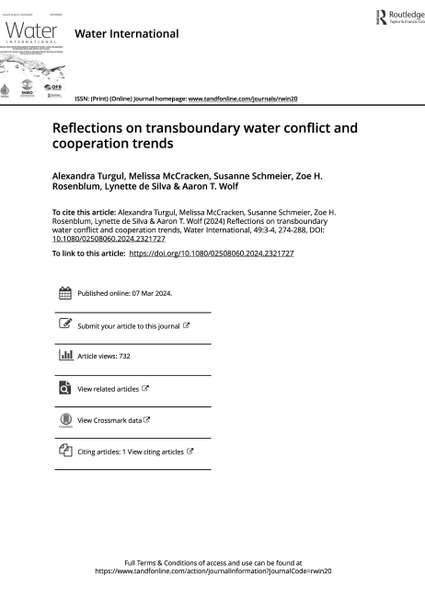
This article explores major findings and evolutions in understandings of transboundary water conflict and cooperation over the last three decades, focusing on the trends emerging from the Transboundary Freshwater Diplomacy Database. It is found that since the 1940s, countries tend to cooperate over shared water resources, in contrast to media portrayals of 'water wars'. Water conflicts, which have increased slightly since 2000, are mostly fuelled by water quantity disputes or unilateral infrastructure developments. Institutions play a role in facilitating cooperation and reducing conflict over shared waters, but their growth and adoption have slowed over the last few decades.
Year: 2020
Collections: Books
Topics: Water, Sustainable Development, Irrigation, IWRM, NEXUS, Water law, Water diplomacy, Water governance, Transboundary Water Resources, Water Security
Authors: Anoulak Kittikhoun, Susanne Schmeier
Countries:
Source: Routledge
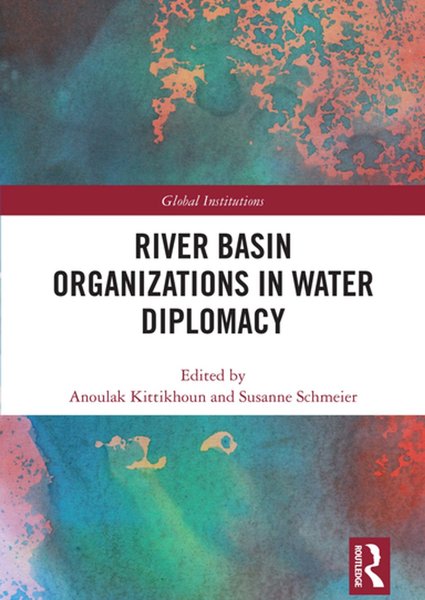
River Basin Organizations in Water Diplomacy explores the role of River Basin Organizations (RBOs) in preventing and resolving conflicts related to transboundary water resources. Through a comparative analysis of international river basins, the book examines how institutional mechanisms, legal frameworks, and diplomatic tools promote cooperation among states and support the sustainable management of shared water resources.
Year: 2022
Collections: Scientific Publications
Topics: Energy
Authors: Rokita Dagmar, Sawatzki Rainer, Szyzdykova Raushan
Countries: Kazakhstan, Kyrgyzstan, Uzbekistan, Tajikistan, Turkmenistan
Source:
Year: 2021
Collections: Research Paper
Topics: Water
Authors: Masoomi B., Jaafarzadeh N., Tabatabaie Tayebeh, Jorfi S., Kouhgardi E.
Countries: Iran
Year: 2023
Collections: Research Paper
Topics: Water, Green business
Authors: Hutson N., Taganova J.
Countries: Kazakhstan
Source: Central Asian Journal of Water Research
Recent geopolitical events have thrust the Caspian region into a time of unparalleled opportunity. Specifically, the Middle Corridor (“MC”) has been presented as a potential savior for trans-Eurasian commerce. At the same time, its success relies on a sea that is in an ecologically precarious state.
Year: 2022
Collections: Scientific Publications
Topics: Sustainable Development, Transportation and logistics
Authors: Taisarinova A.
Countries: Kazakhstan
Source: Central Asian Journal of Sustainability and Climate Research
This research aimed to identify the implementation level of Task 9.1 (Sustainable Development Goal 9) in the Republic of Kazakhstan. The literature review under this study also allowed assessing the degree to which the transport corridors impact the sustainable development of the Central Asian Region. In addition, 97 companies were surveyed and 51 extended interviews were conducted as part of the CILT Central Asia Project to assess the effects of transport corridors on businesses. The study has revealed significant gaps in the SDG9 data collection system, specifically, the need to integrate indicators on the impacts of building new infrastructure in the information collection system for SDG9 evaluation.
Year: 2022
Collections: Policy Briefs
Topics: Water, Gender
Authors: Tankibayeva Aliya, Bouman-Dentener Alice, Ingraham Rachel Fisher
Countries: Kazakhstan, Kyrgyzstan, Uzbekistan, Tajikistan, Turkmenistan, Afghanistan
Source:
● Five Central Asian countries have the right momentum to build genderinclusive WASH
● Transition can accelerate with investments into safe, resource-efficient, scale-appropriate and modern supply and sanitation infrastructure, technologies, and services
● Inclusive WASH systems are resilient when women take an active role in policy decisions at all levels and implementation
Year: 2022
Collections: Scientific Publications
Topics: Climate
Authors: Khaibullina Zh., Amantaikyzy A., Ariphanova D., Temirbayeva R., Mitusov A., Zhurumbetova Zh.
Countries: Kazakhstan
Source:
Year: 2009
Collections: Research Paper
Topics: Water, IWRM, Transboundary Water Resources, Transboundary cooperation
Authors: Teresita Cruz-Del Rosario
Countries:
Source: Australian Journal of International Affairs
The article examines the challenges of cooperative management of transboundary water resources in Central Asia. The author analyzes water relations among Kazakhstan, Kyrgyzstan, Tajikistan, Turkmenistan, and Uzbekistan through Ulrich Beck’s concept of “risk society.” The article argues that water scarcity, the transboundary nature of the Amu Darya and Syr Darya rivers, the Soviet legacy of centralized water management, artificial borders, and ethnic tensions create significant risks for regional stability.
For questions about cooperation, please contact us at: