
Year: 2024
Collections: Scientific Publications
Topics: Water
Authors: Tillakarim T., Serikbay N., Satmurzayev A., Sairov S.
Countries: Kazakhstan
Source: water-ca.org
The research aimed to evaluate the possibility of applying the HBV model for assessing the flow of the Ile Alatau Mountain Range rivers. The main part of the corresponding water resources forms on the northern slopes of the Ile Alatau making them a significant water balance and water supply factor for the major cities of Almaty, Kaskelen, Talgar, and Yesik.
Year: 2013
Collections: Research Paper
Topics: Water, IWRM, Transboundary Water Resources
Authors: Shokhrukh-Mirzo Jalilov, Saud A. Amer, Frank A. Ward
Countries:
Source: Eurasian Geography and Economics
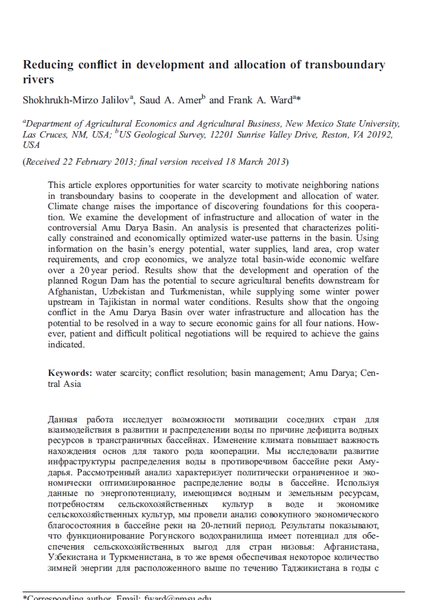
This article explores opportunities for water scarcity to motivate neighboring nations in transboundary basins to cooperate in the development and allocation of water. Climate change raises the importance of discovering foundations for this cooperation. The authors examine the development of infrastructure and allocation of water in the controversial Amu Darya Basin.
Year: 2022
Collections: Scientific Publications
Topics: Energy
Authors: Rokita Dagmar, Sawatzki Rainer, Szyzdykova Raushan
Countries: Kazakhstan, Kyrgyzstan, Uzbekistan, Tajikistan, Turkmenistan
Source:
Year: 2022
Collections: Policy Briefs
Topics: Climate
Authors: Wesch Stefanie, Scheffran Jurgen Kogutenko Larissa, Rheinbay Janna,
Countries: Kazakhstan, Kyrgyzstan, Uzbekistan, Tajikistan, Turkmenistan, Afghanistan
Source:
Cooperative regional mechanisms and multi-stakeholder dialogue; adoption of local crossborder perspectives. Strengthening resilience of vulnerable communities. Monitoring and assessment of climate disaster risks in mountainous regions. Fast response mechanisms and disaster simulation drills.Investment in research on climate adaptation and disaster risk reduction; knowledge transfer and better established links between science and practitioners.
Year: 2023
Collections: Scientific Publications
Topics: Agriculture, Sustainable Development, Management
Authors: Conrad Christopher, Kussainova Maira, Schmidt G.
Countries: Kazakhstan, Kyrgyzstan, Uzbekistan, Tajikistan, Turkmenistan
Source: Central Asian Journal of Sustainability and Climate Research
The increasing demand for food, bioenergy and other agricultural products, as well as the intensification of climate change, pose special challenges for Central Asia’s agricultural sector in terms of implementing sustainable land management. Central Asia is a climate change hot spot. Adaptation measures of agricultural land use to climate change imply new trade-offs in terms of quality and provision of ecosystem services. Based on literature studies, this paper identifies examples of such trade-offs and presents possible solutions. The ecoregions of Central Asia show strong interdependencies. Therefore, a special focus has to be put on the transregional effects of the use of ecosystem services. Against the background of different concepts of sustainable development (ESS, SDG, Global Environmental Syndromes) integrative approaches for sustainable use and design of landscapes are necessary.
Year: 2022
Collections: Policy Briefs
Topics: Water
Authors: Gafurov A., Latinovic M., Schone T. Kogutenko Larissa,
Countries: Kazakhstan, Kyrgyzstan, Uzbekistan, Tajikistan, Turkmenistan
Source:
Adaptation to expected water shortage and increasing water demand has to be undertaken to achieve water security in the future. In-depth studies on the quantification of climate change impact on water resources should be considered. Optimization of water management practices should consider the best economic value between Central Asian countries. Decision making process on water management should be supported with more scientific knowledge. Capacity building measures on the assessment of water availability in times of climate change should be improved.
Year: 2024
Collections: Scientific Publications
Topics: Water
Authors: Azamat Madibekov, Laura Ismukhanova, Askhat Zhadi, Botakoz Sultanbekova, Serik Zhumatayev, Alibek Karimov, Sergei Fokin
Countries: Kazakhstan
Source: https://water-ca.org
The study was conducted in 2023 and comprised a comparative assessment of the state of Lake Markakol’s aquatic ecosystems in surface and bottom water strata. The analysis of bottom water temperatures showed correlation between this parameter and dissolved oxygen concentrations, indicating that pollution caused by organic impurities leads to lake eutrophication, in turn, pro-pelling the extinction of aquatic life. Although the main water physicochemical parameters of Markakol Lake correspond to the oligotrophic type, the shifts in dissolved oxygen and phos-phate content, as well as growth of aquatic vegetation indicate its transition to the mesotrophic type. Higher phosphate content in water is a consequence of pollution disturbing the biological balance, as well as stimulating the reservoir’s eutrophication and increased biological productivity, i.e. algal bloom. In addition, phosphate ions serve an informative indicator of Hazard Class 3 (organoleptically hazardous) anthropogenic pollution. Based on the correlation factor (r), two statistical models were considered for the target lake: 1) Water Pollution: nutri-ent concentrations depending on surface and bottom water temperatures (Model 1); and 2) changes in Water Pollution Indices (biogenic, heavy metals, mean) because of air temperature growth due to global warming of 0.25°C/decade (Model 2).
Year: 2024
Collections: Scientific Publications
Topics: Climate, Energy
Authors: Sergey Vassilyev, Galym Iskakov
Countries: Kazakhstan
Source: Central Asian Journal of Sustainability and Climate Research
The study aimed to evaluate the economic and financial viability of a coal mine methane (CMM) utilization project in Central Kazakhstan, demonstrating a methodology for similar initiatives. The analysis was based on the 2013 project proposed by the US Environmen-tal Protection Agency (EPA) that intended to capture methane emissions from six coal mines for electricity generation, yet was never implemented. The study’s relevance stems from Kazakhstan's 2030 methane pledge, recent progress in the country's climate change-related policy, mineworker mortality in 2023, and the shift of mines ownership. Building upon the technical specifications of the 2013 US EPA project, this research em-ployed standard financial and economic cost-benefit analysis (CBA). The financial model utilized a traditional discounted free cash flow approach, while the economic model in-corporated additional factors like the value of statistical life (VSL), shadow pricing, as well as benefits associated with mitigating ozone health impacts, crop damage, mine ex-plosion risks, and CO2 emissions. The economic model has indicated a positive net pre-sent value of $243 mln and 42% internal rate of return. The financial analysis also sug-gests potential profitability under fair electricity and carbon pricing market conditions. To assess project robustness under varying economic and financial assumptions, the study included a sensitivity analysis. The research has likewise leveraged prior CMM-related studies in Kazakhstan and provides valuable guidance for analyzing similar projects. In addition, it also highlights the need for certain adjustments in the current legislation to incentivize such projects, as well as to promote environmental sustainability and social development by mitigating methane emissions, which aligns with Kazakhstan's climate goals.
Year: 2024
Collections: Scientific Publications
Topics: Water
Authors: Tillakarim T., Serikbay N., Satmurzayev A., Sairov S.
Countries: Kazakhstan
Source: water-ca.org
The research aimed to evaluate the possibility of applying the HBV model for assessing the flow of the Ile Alatau Mountain Range rivers. The main part of the corresponding water resources forms on the northern slopes of the Ile Alatau making them a significant water balance and water supply factor for the major cities of Almaty, Kaskelen, Talgar, and Yesik.
For questions about cooperation, please contact us at: