

Year: 2022
Collections: Scientific Publications
Topics: Water, Irrigation, IWRM
Authors: Conrad Christopher, Usman Muhammad, Kenjabaev Shavkat, Ziganshina Dinara, Kussainova Maira, Nikolayenko Alexandr
Countries: Kazakhstan, Kyrgyzstan, Uzbekistan, Tajikistan, Turkmenistan, Afghanistan
Source:
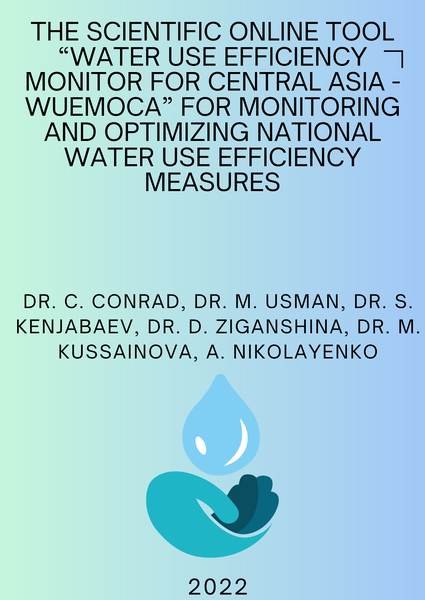
Management interventions to increase water use efficiency in the irrigation sector of Central Asia were introduced but a scientific control instrument is still missing - The online tool WUEMoCA provides relevant irrigation performance indicators in the Aral Sea Basin from satellite data in combination with additional sources - WUEMoCA-based analysis of water security and water use efficiency showed: o 11 out of 33 provinces in the Aral Sea Basin were below the critical level to supply crop water demands for more than 5 years in 2000-2018. o Irrigation water use efficiency is very low in general (55%-60%) and scientific data hints at missing or failing water management interventions in the Amu Darya and Zarafshan basins. - WUEMoCA can strategically supplement the ongoing digitization efforts of the countries in the water sector. - By utilizing WUEMoCA-like tools, Central Asian governments and water management bodies will have new platforms for steering and assessing current and future strategic interventions in regional water management.
Year: 2024
Collections: Policy Briefs
Topics: Sustainable Development, Management
Authors: Usman Muhammad, Liebelt Peter, Catalin Stefan, Klara Dzhakypbekova
Countries: Kazakhstan, Kyrgyzstan, Uzbekistan, Tajikistan, Turkmenistan
Source:
The question of suitable approaches and technologies for more effective and environmentally friendly management of natural resources has great relevance for the countries of Central Asia in the context of the UN Sustainable Development Goals. Despite the wide range of natural resources, Central Asia is still facing increasing land degradation and water scarcity. These problems are being accelerated by land-use pressure and climate change, which is particularly severe in Central Asia. The following recommendations are developed together with scientists from international projects on the use of GIS technologies and modelling approaches for more sustainable resource management.
Year: 2017
Collections:
Topics: Water governance Climate, IWRM, Irrigation,
Authors: Tristam Barrett, Giuseppe Feola, Marina Khusnitdinova, Viktoria Krylova
Countries: Kazakhstan
Source: Human Ecology
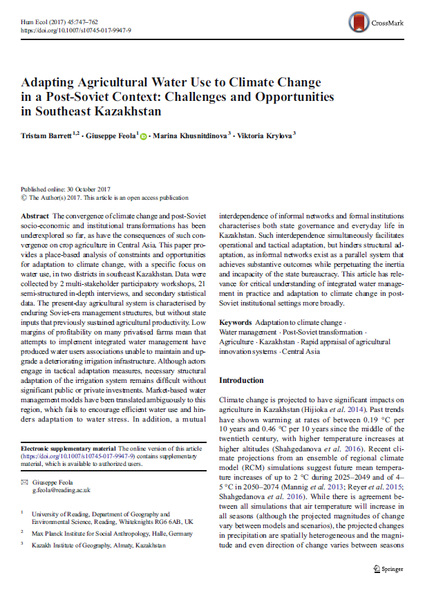
The convergence of climate change and post-Soviet socio-economic and institutional transformations has been underexplored so far, as have the consequences of such convergence on crop agriculture in Central Asia. This paper provides a place-based analysis of constraints and opportunities for adaptation to climate change, with a specific focus on water use, in two districts in southeast Kazakhstan.
Year: 2024
Collections: Policy Briefs
Topics: Climate
Authors: Zhakenova Saltanat, Arsen Tleppayev, Nodir Djanibekov, Viktoriya Krylova
Countries: Kazakhstan, Kyrgyzstan, Uzbekistan, Tajikistan, Turkmenistan
Source:
Universities and academia in Central Asia play a crucial role in addressing climate change impacts, including rising temperatures, diminishing water resources, and increased frequency of extreme weather events threatening agriculture and livelihoods. Academic efforts must prioritize research on tailored adaptation strategies to foster resilience and sustainability. However, there's an underrepresentation of climate change research from Central Asia, emphasizing the urgent need for expanded research efforts.
Year: 2015
Collections: Research Paper
Topics: Water governance, Transboundary Water Resources, Hydropolitics
Authors: Nodir Djanibekov, Kristof Van Assche, Vladislav Valentinov
Countries:
Source: Society & Natural Resources
The article focuses on the problems of transboundary water governance in Central Asia from the perspective of Niklas Luhmann’s social systems theory. The authors examine why, after the collapse of the Soviet Union, it became difficult to coordinate the use of the water-energy infrastructure of the Amu Darya and Syr Darya rivers. During the Soviet period, water, energy, and agriculture were managed through a centralized system. However, after 1991, each country began to develop its own national policy. This strengthened contradictions between upstream countries, which need water for hydropower production, and downstream countries, which need water for irrigation.
Year: 2016
Collections: Short Communications
Topics: Water, Climate, Agriculture, Sustainable Development, IWRM
Authors: Unger-Shayesteh Katy, Gerlitz Lars, Vorogushyn Sergiy
Countries: Kazakhstan, Kyrgyzstan, Uzbekistan, Tajikistan, Turkmenistan
Source: Central Asian Journal of Water Research
An important topic of the journal “Integrated Water Resources Management in Central Asia” will be the assessment of past and future changes in climate and water resources in Central Asia. This technical note aims at providing guidance for sound data-based assessment of changes to be published in this journal. The main requirements for achieving credible results are (1) the use of consistent data series, (2) the selection of appropriate change detection methods, and (3) the discussion of the results, their uncertainties and limitations. Using an example of trend analysis, it is exemplarily shown how inhomogeneities in a data series, the selection of start and end points, the applied methods, and temporal aggregation may affect the results of change studies.
Year: 2017
Collections: Scientific Publications
Topics: Water, Climate
Authors: Mukhamedova Nozilakhon, Wegerich Kai
Countries: Uzbekistan
Year: 2017
Collections: Short Communications
Topics: Water
Authors: Wegerich Kai, Klove B., Xenarios Stefanos
Countries: Afghanistan
Year: 2017
Collections: Scientific Publications
Topics: Water
Authors: Wegerich Kai, Zaryab A., Klove B., Noori Ali Reza
Countries: Afghanistan
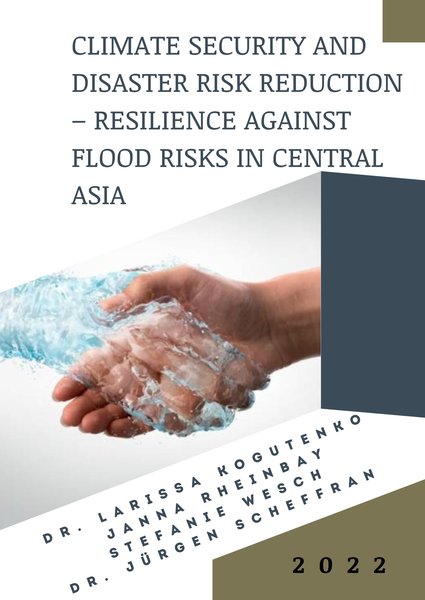
Year: 2022
Collections: Policy Briefs
Topics: Climate
Authors: Wesch Stefanie, Scheffran Jurgen Kogutenko Larissa, Rheinbay Janna,
Countries: Kazakhstan, Kyrgyzstan, Uzbekistan, Tajikistan, Turkmenistan, Afghanistan
Source:
Cooperative regional mechanisms and multi-stakeholder dialogue; adoption of local crossborder perspectives. Strengthening resilience of vulnerable communities. Monitoring and assessment of climate disaster risks in mountainous regions. Fast response mechanisms and disaster simulation drills.Investment in research on climate adaptation and disaster risk reduction; knowledge transfer and better established links between science and practitioners.
Year: 2023
Collections: Scientific Publications, Review article
Topics: Water, Water diplomacy
Authors: Wondwosen Michago Seide, Emanuele Fantini
Countries:
Source: Water Alternatives 16(3): 912-929
This paper aims to foreground the importance of emotions in water diplomacy in general and in Nile water diplomacy in particular. Water diplomacy does not operate from a clean slate, but in a socio-hydropolitically mediated context which is, in turn, imbued with emotions. The existing water diplomacy approach primarily operates with the assumption that the riparian state is a rational actor. However, we argue that emotions have underpinned water diplomacy, including the ongoing Nile negotiations. These emotions are neither acknowledged nor negotiated but are dismissed as irrationality in both the theoretical understanding and practice of water diplomacy.
Year: 2017
Collections: Short Communications
Topics: Water
Authors: Wegerich Kai, Klove B., Xenarios Stefanos
Countries: Afghanistan
For questions about cooperation, please contact us at: