
Year: 2020
Collections: Scientific Publications
Topics: Water
Authors: Hamdard M. H., Soliev I., Xiong L., Klove B.
Countries: Afghanistan
Year: 2020
Collections: Scientific Publications
Topics: Water
Authors: Hamdard M. H., Soliev I., Xiong L., Klove B.
Countries: Afghanistan
Source:
Year: 2017
Collections: Scientific Publications
Topics: Water, Climate
Authors: Klove B., Shokory Jamal Abdul Naser, Tsutsumi Jun-ichiro Giorgos, Yamada Hiroyuki
Countries: Afghanistan
Year: 2017
Collections: Scientific Publications
Topics: Water
Authors: Yerokhin S.A., Zaginayev V.V.
Countries: Kyrgyzstan
Year: 2022
Collections: Scientific Publications
Topics: Sustainable Development
Authors: Idrissov Marat, Yerzakovich Yelena, Dienel Hans-Liudger, Assmann Tom
Countries: Kazakhstan
Source:
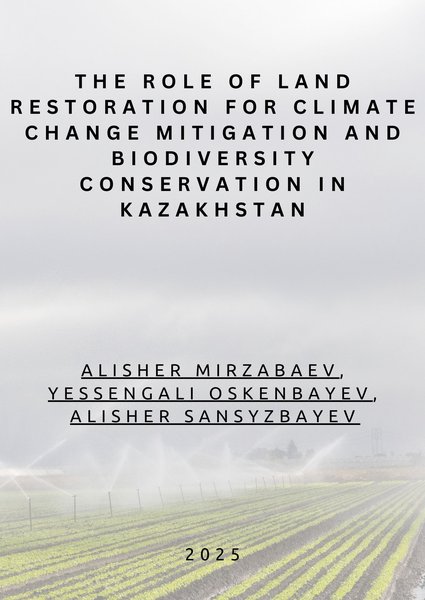
Year: 2025
Collections: Scientific Publications
Topics: Climate, Agriculture
Authors: Alisher Mirzabaev, Yessengali Oskenbayev, Alisher Sansyzbayev
Countries: Kazakhstan
Source: https://cajscr.com
Land restoration in Kazakhstan plays a pivotal role in addressing both climate change mitigation and biodiversity conservation. The country faces significant challenges related to land degradation, including driven by deforestation and shrubland loss, which has substantial economic and environmental impacts. By restoring forests, Kazakhstan can enhance carbon sequestration, particularly in regions such as Eastern Kazakhstan, which has shown notable gains in carbon sinks from land use and land cover changes. Restoration initiatives also align with Kazakhstan’s commitments under the Bonn Challenge, aiming to restore millions of hectares of degraded land by 2030. By analyzing land cover changes from 2001 to 2020, we identified key degradation hotspots and quantified economic losses of approximately 5.6 billion USD, primarily in grasslands and forests. Evaluating three socioeconomic and climatic scenarios—Optimistic, Base, and Pessimistic—revealed that restoration investments ranging from 6.7 to 11.6 billion USD could yield benefit-cost ratios between 1.4 and 4.3, with wetlands and forests restoration emerging as priority areas. These findings highlight the need for an integrated, data-driven approach to align economic viability with environmental sustainability, thereby promoting green growth and enhancing long-term resilience. Land restoration can serve as a cornerstone for achieving Kazakhstan’s environmental goals, fostering synergies between climate mitigation, biodiversity protection, and sustainable development.
Year: 2019
Collections: Conferences
Topics: Water governance, Water diplomacy, Transboundary Water Resources, Transboundary cooperation, Hydropolitics
Authors: B. A. Krasnoyarova, Y. I. Vinokurov, T. V. Antyufeeva
Countries:
Source: IOP Conference Series: Earth and Environmental Science
This article examines the complex challenges of water management in the transboundary Irtysh River Basin shared by China, Kazakhstan, and Russia. The authors emphasize that intensive water withdrawals by China and ongoing infrastructure development in Kazakhstan are contributing to water resource depletion and ecosystem degradation, particularly in the downstream reaches of the river. The study discusses proposed inter-basin water transfer projects aimed at addressing water scarcity, as well as the environmental risks associated with industrial pollution. Particular attention is given to Russia’s limited engagement in transboundary water governance and the need to establish trilateral institutional mechanisms for the joint management of shared water resources. The authors argue that achieving international consensus is essential to preventing further ecological deterioration of the basin. The study concludes by advocating a shift from isolated technical solutions toward an integrated transboundary water governance framework.
Year: 2016
Collections: Concept paper Scientific Publications, Research Paper, Review article,
Topics: Water, Sustainable Development, IWRM, Water law, Water diplomacy, Water governance
Authors: Patrick Huntjens, Yumiko Yasuda, Ashok Swain, Rens de Man, Bjørn-Oliver Magsig, Shafiqul Islam
Countries: N/A
Source: The Hague Institute for Global Justice
This publication is part of the project Water Diplomacy: Making Water Cooperation Work, led by The Hague Institute for Global Justice, in collaboration with Stockholm International Water Institute (SIWI), UNESCO Category II Centre for International Water Cooperation (ICWC), International Union for Conservation of Nature (IUCN), Uppsala University, University of Otago, University College Cork and Tufts University Water Diplomacy Program.
Year: 2018
Collections: Scientific Publications, Review article
Topics: Water, Water diplomacy
Authors: Yumiko Yasuda, Douglas Hill, Dipankar Aich, Patrick Huntjens, Ashok Swain
Countries:
Source: Water International
This article analyzes key factors affecting transboundary water cooperation in the Brahmaputra River basin at multiple scales. The analysis of multi-track diplomacy reaffirms the potential of actor-inclusive approaches, arguing for a need to go beyond purely focusing on formal legal norms and consider the possibilities of cultural norms of informal processes of cooperation. Various ‘windows of opportunity’ exist in the current phase of the Brahmaputra basin’s development, leading to exploration of a Zone of Possible Effective Cooperation, arising from the effort to scale up multi-track initiatives as well as broader geo-politicaleconomic changes happening across and beyond the basin.
Year: 2017
Collections: Scientific Publications
Topics: Water
Authors: Yerokhin S.A., Zaginayev V.V.
Countries: Kyrgyzstan
Year: 2018
Collections: Scientific Publications, Review article
Topics: Water, Water diplomacy
Authors: Susanne Schmeier, Zaki Shubber
Countries:
Source: Journal of Hydrology
Water diplomacy needs institutional anchoring. International River Basin Organizations (RBOs) – being the result of diplomatic efforts by riparian states intending to create a framework for cooperation between themselves over shared water bodies – can provide such institutional anchors. RBOs ensure that agreements to cooperate are turned into a long-term commitment by riparian states to jointly manage shared water resources and, in turn, foster mutually beneficial cooperation over time. RBOs have been the subject of detailed examinations of their conceptual core, of their manifold functions, of their effectiveness in achieving their goals and so forth. However, the legal nature of these entities has so far received limited attention notwithstanding its significance in empowering RBOs to act as institutional anchors for water diplomacy.
For questions about cooperation, please contact us at: